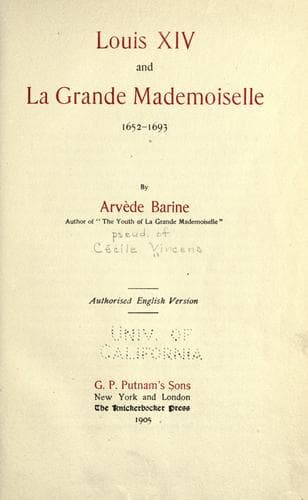
Louis XIV and La Grande Mademoiselle, 1652-1693Barine, Arvède
History
Louis XIV and La Grande Mademoiselle, 1652-1693
Barine, Arvède
Louis XIV, King of France, 1638-1715; Montpensier, Anne-Marie-Louise d'Orléans, duchesse de, 1627-1693
In vain she fought against such cruel exactions; she was forced to make
a spectacle of herself, still with "discomposed face, red and swollen
eyes, with constant floods of tears, at proper or improper moments, with
sharp cries at sight of Lauzun."
Lauzun opened his eyes wide upon her as upon a naughty child, and
severely menaced her: "If you act in this manner, I will never be found
again in the same room with you!" But she could not compose herself. One
evening, at a great Court ball, she stopped in the middle of a dance and
began to weep. The King rose and placed his hat before her face, leading
her out of the room and explaining, "My cousin has vapours." The public
did not pity her. It would have liked to celebrate her defeat. "All have
praised the King for this action," wrote Olivier d'Ormesson.
Louis XIV. was again popular, a transient popularity which lasted only a
few days. "It may be said that not only the Court, but the entire
kingdom has rejoiced in the rupture of the proposed marriage."[261] The
sentiment of approval was unanimous. As to the Princess, who was guilty
of asserting the right to "personal happiness," opinion judged her
severely. The seventeenth century did not admit, as has been seen, that
individual sentiments or the interests of the heart could predominate
over the exactions of rank or society, and the age of the lovers and
disparity of their appearance, she so tall, he almost a dwarf, aroused
ridicule instead of sympathy. The Grande Mademoiselle was suddenly
rewarded "with contempt," "for," says La Fare, "if this contemplated
alliance appeared extraordinary as soon as the news was made public, it
became ridiculous as soon as it was broken."
It is agreeable to meet among these people, who were right in the main,
but who were malicious and uncharitable, one good Samaritan.
While Mme. de Sevigne wrote gaily, "All is finished,"[262] the tears of
Mademoiselle inspired kind and courageous words from a person
comparatively obscure, and who excused herself from corresponding
because she did not have enough "wit." A letter, dated January 21, 1671,
addressed to Bussy-Rabutin by Mme. de Scudery, sister-in-law of the
illustrious Madeleine, contains this paragraph:
I will say nothing of the affair of Mademoiselle. You are no
doubt acquainted with all that has passed. I will only add
that, if you realise what a great passion can be, in the heart
of a pure woman like the Princess, you will not wonder, but
will have sympathy. For myself, who know nothing of love
through experience, I comprehend that Mademoiselle is much
to be pitied; for she has become sleepless. During the day she
is agitated and weeps, and in fact is leading the most miserable
existence possible.[263]
Bussy-Rabutin replied (A Chaseu, January 29, 1671):
Public-domain text, read in full here on John Shaqi.
Reviews
Reviews
No reviews yet
Be the first to share your thoughts on this work.
Elsewhere in the archive
Join the Discussion
Join the discussion
Sign in to leave a comment or review.
Sign InorCreate an account