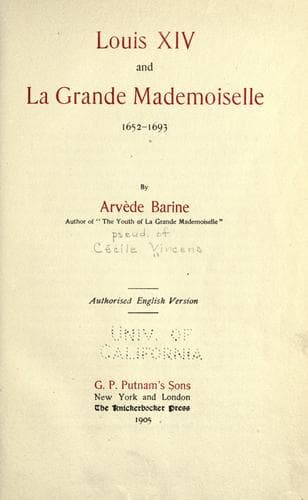
Louis XIV and La Grande Mademoiselle, 1652-1693Barine, Arvède
History
Louis XIV and La Grande Mademoiselle, 1652-1693
Barine, Arvède
Louis XIV, King of France, 1638-1715; Montpensier, Anne-Marie-Louise d'Orléans, duchesse de, 1627-1693
[Footnote 262: Letter dated December 24, 1670.]
[Footnote 263: _Correspondance de Bussy-Rabutin_, published by Ludovic
Lalanne.]
CHAPTER VI
Was Mademoiselle secretly Married?--Imprisonment of
Lauzun--Splendour and Decadence of France--_La Chambre
Ardente_--Mademoiselle purchases Lauzun's Freedom--Their
Embroilment--Death of the Grande Mademoiselle--Death of
Lauzun--Conclusion.
Many of the events remaining to be recorded are very obscure. If they
had any importance, they would have figured in the collections of
historic enigmas and problems waiting to be solved; but they hardly
merit the honour, as few of them have had any such influence over the
destinies of France as had, for instance, the fact of the subjection of
Anne of Austria to Mazarin. Nor do any possess the romantic attraction
which attached to the legend of the "Man with the Iron Mask" before its
explanation. Petty details, however, bring the French society of this
period near to us, and the fact that events cannot always be interpreted
makes them seem more like real life. It is only in romances that all is
explained.
The most obscure of these smaller problems is the question of the
marriage of Mademoiselle with the "little man," as she herself called
him.
Contemporary opinion has been almost unanimous in its belief in this
marriage. Neither date nor place nor names of the possible witnesses
have ever been satisfactorily established, as was done in the case of
the union of Louis XIV. and Mme. de Maintenon. There is no written proof
of the fact; Mademoiselle had the habit of burning her letters, and made
no exception in favour of those from Lauzun. She states this fact with
regret, in her _Memoires_. We are thus reduced to moral proofs. It is
true that these are strong in favour of the event having taken place;
but they are not altogether unanswerable.
The belief that a secret bond had remained, after the official rupture,
rested in the mind of most people interested. One of the
correspondents[264] of Bussy-Rabutin wrote to him, February 17, 1671:
"Mademoiselle sometimes still weeps when she reflects, but often she
laughs and is at her ease. Her lover continues to see her and no one
opposes it. I do not know what will happen." Three weeks later, Mme. de
Scudery made allusion to the same rumour (Paris, March 6, 1671):
"Mademoiselle is always conversing with M. de Lauzun. Their
conversations begin and end with tears. I assure you, however, that
there will be no result." Bussy was among those who believed that it
"would come to something." He replied on the 13th to Mme. de Scudery: "I
am convinced that the affair of Mademoiselle and Lauzun will have a
happy issue, not in the manner they at first hoped, but in a more secret
method to which the King will consent."
Public-domain text, read in full here on John Shaqi.
Reviews
Reviews
No reviews yet
Be the first to share your thoughts on this work.
Elsewhere in the archive
Join the Discussion
Join the discussion
Sign in to leave a comment or review.
Sign InorCreate an account