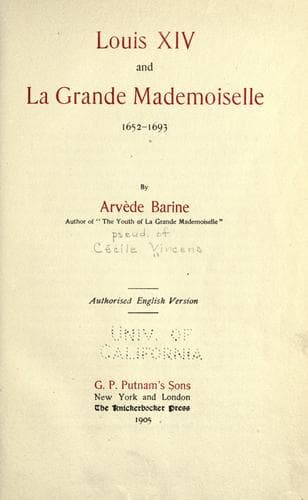
Louis XIV and La Grande Mademoiselle, 1652-1693Barine, Arvède
History
Louis XIV and La Grande Mademoiselle, 1652-1693
Barine, Arvède
Louis XIV, King of France, 1638-1715; Montpensier, Anne-Marie-Louise d'Orléans, duchesse de, 1627-1693
Would Mademoiselle accept this other way? Doubt is permissible.
_Marriages of conscience_, if fashionable in the seventeenth century,
created false situations, sometimes very humiliating ones, to a person
not an absolute sovereign accountable to no one, and in a position to
let the truth come out or not as it pleased him. For the rest of
mortals, secret marriages must actually remain concealed, or there would
result endless difficulties. On this account, the married pair could
only meet through a happy chance, which is not agreeable, while it was
also almost impossible to escape suspicious commentaries and the
uncomfortable dependence upon the fidelity of servants. Segrais would
never believe that Mademoiselle had married Lauzun, and one of the
reasons given was "that she sent away Madelon, her chambermaid, and she
would not have done this if Madelon had been able to gossip." Segrais
might have added that his mistress had always severely criticised the
equivocations arising from _marriages of conscience_.
But all was changed after the serious conversation between the King and
Mademoiselle behind the closed doors. Mademoiselle encouraged Lauzun to
assume airs of authority, and she was meekly submissive. "He regarded me
with such a look that I no longer dared to weep, the power that he had
over me retaining my tears. It is much wiser not to lose self-control!"
It was by his advice that she cleared her palace of all who had blamed
their first plan. M. de Montausier and Mme. de Sevigne tried in vain to
save Segrais, who "was their special friend." "She cannot be touched,"
wrote Mme. de Sevigne, "upon a subject which approaches to within nine
hundred leagues of a certain cape."[265] It was Lauzun who designated
the successor of Guillore, her Intendant, and who submitted the choice
to the King. This might give rise to remark. Lauzun warned Mademoiselle
of this danger. "It may be said in the world that I wish to rule you
completely." She responded: "Please God that you should; that is what I
profoundly desire." Mademoiselle had confirmed through new acts the
lavish gifts assured by the contract, and the King rivalled his cousin
in generosity. If the courtiers can be believed, Louis had promised
Lauzun that he should lose nothing by _not_ marrying Mademoiselle. In
any case, he heaped favours upon him. The first gift was the government
of Berri, with fifty thousand francs to pay his debts and the hope that
Fortune would continue her benedictions. Louvois grew anxious and
amassed shiploads of hatred against the favourite.
Public-domain text, read in full here on John Shaqi.
Reviews
Reviews
No reviews yet
Be the first to share your thoughts on this work.
Elsewhere in the archive
Join the Discussion
Join the discussion
Sign in to leave a comment or review.
Sign InorCreate an account