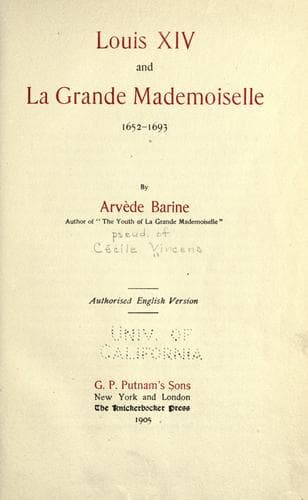
Louis XIV and La Grande Mademoiselle, 1652-1693Barine, Arvède
History
Louis XIV and La Grande Mademoiselle, 1652-1693
Barine, Arvède
Louis XIV, King of France, 1638-1715; Montpensier, Anne-Marie-Louise d'Orléans, duchesse de, 1627-1693
Monseigneur, M. de Nallot arrived here on the fifth instant,
conveying the note of instructions you have been pleased to
send me.... He will report to you my haste in preparing the
apartment for M. de Lauzun; he will tell you, Monseigneur, that
I will lodge him in the two low vaulted chambers which are over
those of M. Foucquet: these are the ones with the barred
windows you yourself[268] examined. From the way in which I
have arranged the place, I can respond with my life for the
safety of the person of M. de Lauzun, and also the certainty of
intercepting any news sent or received.
I engage upon my honour, Monseigneur, that as long as this
gentleman is under my care you will hear no further word about
him, it will be as if he already lay _in pace_.
The place prepared is so constructed that I can have holes
made, through which I can spy into the apartment. I shall also
know all that he does and says through the reports of a valet
whom I will furnish as you have ordered; I have found one with
much trouble, because the clever ones do not wish to pass their
life in prison. You order that mass shall be celebrated for M.
de Lauzun only on fete days and Sundays and I will scrupulously
follow the letter of your instructions.... The Confessor of M.
Foucquet will attend the new prisoner on Easter and at no other
time, whatever may happen. My only desire is to carry out exactly
the orders with which you have honoured me: I shall always endeavour
to do this with zeal, passion, and fidelity, so I trust that you
may be content with my small services.[269]
All the officials of the citadel had written to Louvois after the
arrival of his agent, so great an impression had been made. It was said
that M. de Lauzun was a great criminal and a very dangerous one to
necessitate such precautions. Each wished to show his special zeal.
Louis XIV. was also well informed about the prison destined for his old
favourite.
Louvois showed the King the plan he had received. The apartment
consisted of two low vaulted rooms facing a deserted court, through
which no one ever passed. The windows were darkened by iron bars and
were covered with a sort of basket-work used in prisons, to prevent the
occupant seeing or being seen. Noises from without, even those from the
guards and the kitchen, did not penetrate into this remote place, the
most "noiseless" of all the citadel, on account of the enormous
thickness of the walls and of the vaulting. "Never," said one of the
letters, "will M. Foucquet know that he has a companion." The
correspondents of Louvois unanimously insisted upon the necessity of
preventing any risk of escape. A screen of iron was placed in the
embrasure of the windows and a _vissante_ inserted in the chimney to
prevent M. de Lauzun and M. de Foucquet from communicating with each
other.
Public-domain text, read in full here on John Shaqi.
Reviews
Reviews
No reviews yet
Be the first to share your thoughts on this work.
Elsewhere in the archive
Join the Discussion
Join the discussion
Sign in to leave a comment or review.
Sign InorCreate an account