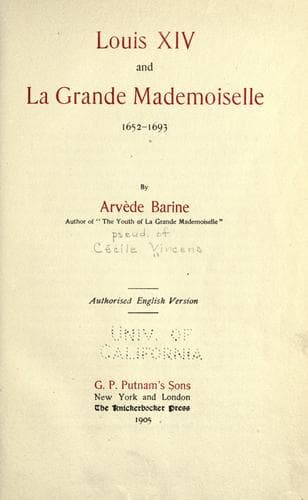
Louis XIV and La Grande Mademoiselle, 1652-1693Barine, Arvède
History
Louis XIV and La Grande Mademoiselle, 1652-1693
Barine, Arvède
Louis XIV, King of France, 1638-1715; Montpensier, Anne-Marie-Louise d'Orléans, duchesse de, 1627-1693
Saint-Mars had another grief. Louvois recommended to him incessantly to
make his prisoner talk and to report every word, even the most trivial,
but Lauzun would not utter a syllable. "I do not know why," wrote
Saint-Mars, naively, "but he distrusts me, and hardly dares to speak to
me" (February 10, 1672). On March 19: "He is always in a state of
extraordinary distrust of me." Louvois insisted, and received
discouraged letters. (March 30:) "When I make a visit, our conversation
is so dry and difficult that we often pace the room a hundred times
without interchanging a word." Saint-Mars in vain sought innocent
topics. He tried to converse about the weather. M. de Lauzun interrupted
him under the pretext that the state of the weather was a matter of
indifference to him, since, from his dungeon, he could see "neither moon
nor sun."
Saint-Mars inquired about his health. M. de Lauzun cut him short, in
declaring that "his health was a matter of no consequence to any one,
and that he was really only too well." Saint-Mars did not know what more
to say. He became furious. Lauzun perceived this, and grew even more
taciturn. It was a fair and even fight. At the end of a year, Saint-Mars
had not advanced an inch.
[January 7, 1673] When I said good morning or good evening, and
when I asked him how he felt, he made low bows, saying that he
was well enough to offer his most humble respects; after having
thanked him, we walked some time together without speaking to
each other, and, as I wished to retire, I asked him if he had
anything to demand. He made again a very low bow and conducted
me to the door of the room; this is the point at which we have
arrived, and I am afraid that we shall make no further
progress.
Saint-Mars tried to force the situation. It was he who furnished the
prisoner with everything; who gave him clothes, furniture, bought his
eye-glasses, or ordered a wig. He thought that a method of making him
speak would be to give him nothing that he did not demand. Lauzun
invented a mute language.
Saint-Mars would perceive, in entering, some wornout or broken object
placed in a conspicuous position, having the air of saying something.
"Sometimes," wrote the governor of the citadel, "I feign not to notice,
and in order to oblige me to speak, Lauzun will direct his steps so as
to pass the object again and again until I am forced to comprehend."
(May 6, 1672.)
The valet was almost as close as his master. Saint-Mars did not cease to
lament the trouble which "these people" gave him. Prisoners' valets
shared the fate of their masters. Once confined, they passed the sill of
the prison only with the culprit; that is to say, in many cases never,
which fact rendered it extremely difficult to procure servants. The one
with Lauzun was a "wicked rascal" who had been bribed, but who at the
end of three months refused to do his duty as spy.
Public-domain text, read in full here on John Shaqi.
Reviews
Reviews
No reviews yet
Be the first to share your thoughts on this work.
Elsewhere in the archive
Join the Discussion
Join the discussion
Sign in to leave a comment or review.
Sign InorCreate an account