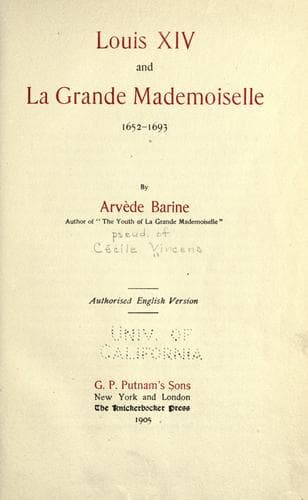
Louis XIV and La Grande Mademoiselle, 1652-1693Barine, Arvède
History
Louis XIV and La Grande Mademoiselle, 1652-1693
Barine, Arvède
Louis XIV, King of France, 1638-1715; Montpensier, Anne-Marie-Louise d'Orléans, duchesse de, 1627-1693
Saint-Mars was indignant (February 20, 1672): "With your permission, I
will put him [the valet] in a place that I reserve, which makes the dumb
speak after a month's sojourn. I shall learn all from him, and I am
certain that he will not forget the least trifle." Upon reflection,
however, Saint-Mars ended by being patient. How was he to replace the
fellow? "No one of the valets attached to the citadel would enter this
dungeon if I paid him millions. They have noticed that those whom I have
placed with M. Foucquet never come out." Louvois never knew, in spite of
earnest desire, what thoughts the fallen favourite was conceiving in his
prison.
There was a slight recompense, however, on the days on which Lauzun fell
into a rage, which often happened. The prisoner could not digest the
fact that his questions remained unanswered. This might be reasonable
enough if he asked if France were at war, or if Mademoiselle were
married; but why refuse news of his own affairs? Why conceal from him
the fact of his mother being alive or dead? His vexation became rage. He
poured out a torrent of imprecations and bitter complaints, and Louvois
had the pleasure of hearing by the next mail that silence did not
indicate absence of suffering.
One day (January 28, 1673), after giving an account of one of these
explosions, Saint-Mars added: "He said all this, weeping hot tears and
crying that he detested his miserable life; he complained loudly of the
horrible dungeon which I have given him, where he has lost his sight and
his health." The wails of grief echoed even through Paris, leaking out
from the cabinet of Louvois and the chamber of Mme. de Montespan, and
the public demanded with curiosity what Lauzun had done to deserve a
punishment so rigorous. "I can never believe," wrote Mademoiselle,
"that it is by the orders of the King." It was easily guessed that
Louvois was avenging his frights and Mme. de Montespan her humiliations;
but why did the King permit such severity? for Louis had never appeared
to take very much to heart the entanglements of these two Court powers
with his favourite.
It is needful to recollect that the seventeenth century had no greater
respect for human liberty than for human life. Only rank and birth were
of value, and these were honoured in a greater degree than it is
possible now to comprehend. This same Louvois, who was tormenting Lauzun
almost to the point of insanity, had hastened to send him a
silver-service, and had asked him to complain if his guards were
impolite.
"M. de Saint-Mars," wrote the Minister, "has orders never to fail in
according the respect due to your birth and to the position which you
have held at Court" (December 12, 1672). From like considerations, the
birth of Lauzun had brought him new furniture, but not a single object
of any kind which could aid him in inventing occupation or employment.
Public-domain text, read in full here on John Shaqi.
Reviews
Reviews
No reviews yet
Be the first to share your thoughts on this work.
Elsewhere in the archive
Join the Discussion
Join the discussion
Sign in to leave a comment or review.
Sign InorCreate an account