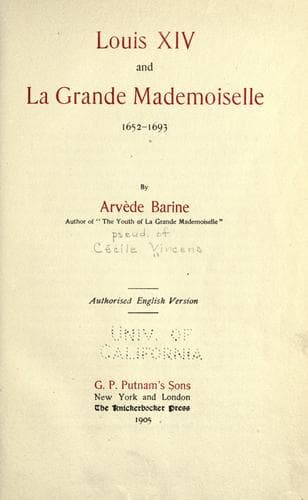
Louis XIV and La Grande Mademoiselle, 1652-1693Barine, Arvède
History
Louis XIV and La Grande Mademoiselle, 1652-1693
Barine, Arvède
Louis XIV, King of France, 1638-1715; Montpensier, Anne-Marie-Louise d'Orléans, duchesse de, 1627-1693
He descended by this ladder to the moat surrounding the fortress,
"pierced the wall on the side of the moat,"[272] encountered a rock, and
recommenced at a short distance from the place of the first attempt";
the new passage led into a court of the citadel. Lauzun reached the
ground one morning at daybreak. He had passed three days in scraping; it
was this occupation which had kept him tranquil. Only an open door, and
he would have been saved. He would well have deserved success as a
reward for his industry and patience. But all was firmly closed, and he
was stopped by an incorruptible sentinel.
The poor prisoner was brought back to his dungeon, and Louvois stormed
at the authorities of Pignerol, who permitted walls and windows to be
demolished without perceiving that anything strange was occurring.
Repairs and numerous new measures of precaution were ordered, and
Saint-Mars, very much abashed, swore by all the gods that such a thing
should never again happen.
In spite of these oaths, many of the prisoners succeeded in gaining
access to their neighbours, according to the account of
Saint-Simon.[273] It seems that the open chimneys of ancient times had
become an ordinary means of communication between the dungeons of
Pignerol. "A hole was made in the pipe, which was carefully closed
during the day," and with mutual aid the prisoners ascended and
descended. Lauzun was placed in relation with various prisoners, of whom
one was Foucquet, who believed him to be mad when listening to his
account of the failure of the plan of marriage with the Grande
Mademoiselle. These gentlemen must have resembled chimney sweeps.
Saint-Mars, however, only knew of these practices after the death of
Foucquet; the troubles of Lauzun were then at an end. The death of the
eldest brother, which occurred in 1677, had brought new conditions.
Lauzun became head of the family. His sister, Mme. de Nogent,
represented to the King that it was needful for the preservation of the
"House" that M. de Lauzun should be permitted to put his affairs in
order, and she had no difficulty in obtaining a hearing. Although the
individual counted for little, the "House" was a thing sacred, even in
the eyes of Louis XIV. Saint-Mars was ordered to receive Mme. de Nogent,
another of the brothers, Chevalier de Lauzun, and their advocate, M.
Isarn, and to permit them to meet with his prisoner, exacting the
promise that only business should be discussed. He forbade a single
word, "under any pretext whatever," of Mlle. de Montpensier. An account
of these interviews, sketched by Isarn, remains. It must not be
forgotten in reading this document that Lauzun had a great interest in
inspiring a lively pity in the hearts of these people who were returning
to Paris. After long preliminaries, Isarn arrived for the first
interview with Lauzun, whom no one had seen for six years.
Public-domain text, read in full here on John Shaqi.
Reviews
Reviews
No reviews yet
Be the first to share your thoughts on this work.
Elsewhere in the archive
Join the Discussion
Join the discussion
Sign in to leave a comment or review.
Sign InorCreate an account