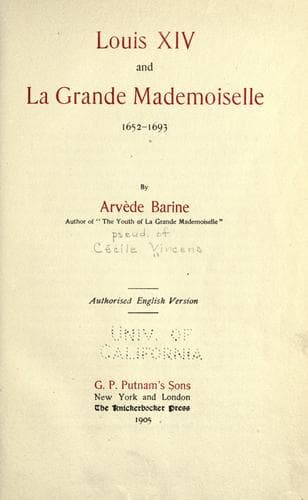
Louis XIV and La Grande Mademoiselle, 1652-1693Barine, Arvède
History
Louis XIV and La Grande Mademoiselle, 1652-1693
Barine, Arvède
Louis XIV, King of France, 1638-1715; Montpensier, Anne-Marie-Louise d'Orléans, duchesse de, 1627-1693
This was the real punishment: a complete inaction with not a single echo
from the outer world which might prevent his mind from continually
turning inward upon itself. Lauzun only obtained a few books at long
intervals, and always with great difficulty, after every page had been
examined in detail; messages written in invisible ink were feared, and
phrases which might throw light upon the events of the day. When the
choice of literature was left to Saint-Mars, he confined himself to _Le
Tableau de la Penitence_ or the _Pedagogue chretien_. The contents of
these were well known and, also, "they might be useful to lighten his
despair."
It will be remembered that Mademoiselle had scolded the "little man" to
make him take greater care of his person and toilet. In prison, Lauzun
had grown very careless. (April 20, 1672:) "He grows so negligent that
for three weeks he has worn a handkerchief knotted around his neck in
place of a cravat." From note of July 30, 1672, more than seven months
after his arrival: "He has not had his room swept, nor his glass rinsed;
he is extremely negligent." Lauzun had permitted his beard to grow,
which contributed to his neglected appearance. Saint-Mars declared that
it was a half-yard long. (February 11, 1673:) "He is as disorderly at
his meals as in his person and in his apartment."
Years passed. In 1673, they pruned the trees which cut off the light.
This was the only change. In 1674, the prisoner almost died. His health
was shattered and his temper changed. He became tranquil, except for an
occasional access of anger, and was very polite to his jailer, who
attributed this metamorphosis to the effects of the books of piety and
the holy water freely supplied. Saint-Mars found him "very often" on his
knees, saying his prayers before an image of the Virgin, and had much
joy in the change.
In 1676, in the month of February, Louvois received a letter,[271] the
contents of which passed through Paris like a flash of lightning. M. de
Lauzun had almost succeeded in effecting his escape; and neither by door
nor window, the ordinary method in romances. He had made a hole in the
dungeon of Pignerol by scratching with old knives, pieces of kitchen
utensils, etc., and had succeeded in piercing the thick vault below his
chamber. Lauzun rolled through this opening, and found himself between
four walls, before a barred window. He began again to scrape; he
demolished one of the corners of the window, unfastened one of the bars,
and saw that he was several fathoms above the ground. His foresight had
caused him to collect a quantity of napkins, from which he made a rope
ladder; "the best made in the world," wrote Mademoiselle, with
admiration for the sample sent to Louvois.
Public-domain text, read in full here on John Shaqi.
Reviews
Reviews
No reviews yet
Be the first to share your thoughts on this work.
Elsewhere in the archive
Join the Discussion
Join the discussion
Sign in to leave a comment or review.
Sign InorCreate an account