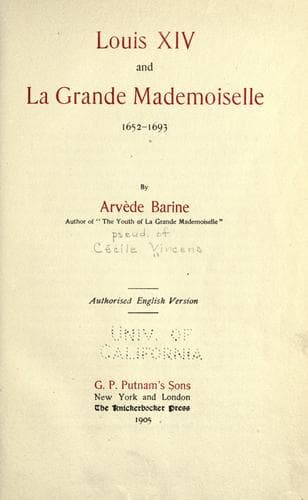
Louis XIV and La Grande Mademoiselle, 1652-1693Barine, Arvède
History
Louis XIV and La Grande Mademoiselle, 1652-1693
Barine, Arvède
Louis XIV, King of France, 1638-1715; Montpensier, Anne-Marie-Louise d'Orléans, duchesse de, 1627-1693
La Voisin, the poisoner, cannot be forgotten, nor the prosecution in
1668, which had revealed to the young King the connection of his new
mistress with the world of malefactors. This affair was stifled, but the
evil continued in its subterranean influence. The merchants of love
philters and of poisons and the priests of satanic rites saw their
clients increasing in number year by year. When the crimes finally came
to the surface, and Louis established (March 7, 1679) the "_Chambre
ardente_" to purify France from the gangrene, so many Parisians were
connected in one way or another with the accused that the King had
against him a powerful current of opinion. This is, perhaps, the most
significant feature of the sad affair. Instead of being crushed with
shame in learning how many were compromised, the higher classes were
indignant against the equal justice which refused to give them special
consideration. They murmured loudly, and for once the people were with
them, for the populace remained staunch to the sorcerers. The clamours
were so menacing that the judges of the "_Chambre ardente_" felt
themselves in danger: "I know," wrote Bussy-Rabutin on April 1st, "the
chamber instituted to examine the 'corrupters,' and also know that
Messieurs de Bezons and de La Reynie do not pass from Paris to Vincennes
without an escort of the Kings Guards."[286] Louis XIV. was obliged
several times to strengthen the resolution of these judges; sometimes in
openly commanding them to "judge truly"[287] without any distinction of
person, condition, or sex; sometimes by assuring them through official
letter of his "protection."[288]
The first executions before the _Chambre ardente_ took place in
February, 1679, and the list of the names of those arrested or of those
to whom notices of warrants to appear as witnesses had been served, a
list which made so great an excitement on account of the aristocrats
included,[289] is dated January 23, 1680. It had been at least four
months before,[290] that there had come to the ears of the King, as some
one was reading to him the account of the last examinations, two
familiar names. Who is Mlle. des [OE]illets, ancient "follower" of Mme.
de Montespan? Who is Cato, her maid, and what had they to do with La
Voisin and with those like her? These same names again appearing in the
list of January 6, 1680, the King, while declaring that the witnesses
must certainly have lied,[291] ordered the Procurer-General, M. Robert,
"to pay strict attention to this particular case."
Public-domain text, read in full here on John Shaqi.
Reviews
Reviews
No reviews yet
Be the first to share your thoughts on this work.
Elsewhere in the archive
Join the Discussion
Join the discussion
Sign in to leave a comment or review.
Sign InorCreate an account