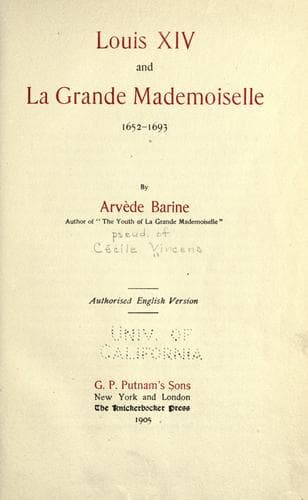
Louis XIV and La Grande Mademoiselle, 1652-1693Barine, Arvède
History
Louis XIV and La Grande Mademoiselle, 1652-1693
Barine, Arvède
Louis XIV, King of France, 1638-1715; Montpensier, Anne-Marie-Louise d'Orléans, duchesse de, 1627-1693
This was done, with the result that Louis was forced to ask himself if
the woman whom he adored above all others, and who had borne him seven
children, was a vile "corrupter"; if this perfect body for which he had
risked the safety of his soul had taken part in the ignoble ceremonies
of the infamous Guibourg? If, discontented with the thought of sharing
his favours with rivals, she might not in an access of jealousy have
tried to poison him, the King? He sought the truth, but did not find it.
In waiting further developments, Louis led his mistress with him
wherever he might go, and she was always making a disturbance of some
sort. The King grew less patient; that was the only difference.
From Bussy-Rabutin, May 18, 1680:
"The King ... as he was mounting into his carriage with the Queen had
some rough words with Mme. de Montespan, about the scents with which she
deluged herself, which made his Majesty ill. The King at first spoke
politely, but as she responded sharply, his Majesty grew warm." On the
25th, Mme. de Sevigne noted another "serious embroilment." This time
Colbert succeeded in reconciling them. The situation grew painful. A
long series of letters and _memoires_ have been found in which La Reynie
discusses for the King the charges accumulated against Mme. de
Montespan. The picture is given of the doubts and fluctuations of an
honest man whose responsibilities somewhat rankle in his breast, and who
sees an equal peril in dishonouring the throne and in permitting a
guilty woman to remain near the King. Louis passed through many
successive stages of conviction during the prosecution. The further the
examination proceeded, the stronger became the presumption of guilt,
without, however, bringing positive proofs.
On July 12, 1680, La Reynie summed up for his master the history of the
"petition to be used in poisoning the King." On October 11th he declared
that he should be ruined in the affair, and supplicated his Majesty to
reflect whether it would be for the "welfare of the State," to make
these "horrors" public. In the month of May following, he avowed that he
had erred on some points and that there was more evil than at first
appeared. The marvellous control that Louis possessed over himself
prevented outward betrayal; but certainly these uncertainties, these
inferior conflicts, and it is to be hoped some sense of shame and
remorse, became chastisements for his faults. On her side, Mme. de
Montespan, in spite of the secret of her possible guilt being well
guarded both at Court and by the judges and police, could not be
ignorant that Mlle. des [OE]illets had been interrogated, confronted
with witnesses, and imprisoned for life in the general Hospital at
Tours.[292] Mme. de Montespan then knew that she had been denounced, but
with what proof? What did the King think? What curious meetings between
these two beings must have taken place. What conversations during which
the King and his mistress were closely observing each other.
Public-domain text, read in full here on John Shaqi.
Reviews
Reviews
No reviews yet
Be the first to share your thoughts on this work.
Elsewhere in the archive
Join the Discussion
Join the discussion
Sign in to leave a comment or review.
Sign InorCreate an account