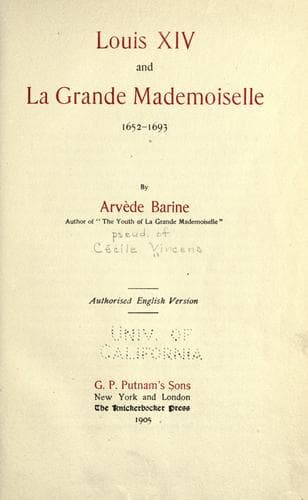
Louis XIV and La Grande Mademoiselle, 1652-1693Barine, Arvède
History
Louis XIV and La Grande Mademoiselle, 1652-1693
Barine, Arvède
Louis XIV, King of France, 1638-1715; Montpensier, Anne-Marie-Louise d'Orléans, duchesse de, 1627-1693
The fifth day they again disputed. Lauzun was in the wrong; he had
spoken of his visits to Choisy as duties. Mademoiselle, however, injured
her cause with sharpness. "I see clearly," said she, "that in this world
people who do good are mocked, as they are bores." Lauzun, vexed,
demanded, "How much longer is this pleasantry to last?" "As long as I
please; I have the right to say all I wish, and you are bound to
listen." Lauzun showed "much impatience to depart," and this was not
altogether unnatural, considering the nature of man. At another
interview, it was the lover who was the first to show irritation. To be
no longer of any importance in the world of society, to be two steps
from the Court without being free to enter, this was more than he could
bear. He accused Mademoiselle of having managed very badly and having
only done harm; "if she had not interfered with his affairs," he would
have come out of prison under better conditions. Mme. de Montespan
overheard the accusation and was very indignant at this injustice and
ingratitude, and the Princess united with her in reproaches. It would be
difficult to find a clear moment in the midst of these frequent
quarrels, in which the pair would have desired to marry, if they had not
done so before Pignerol. Here is again a moral proof to add to the
others.
About every two days, Lauzun became metamorphosed, and was again for
some hours, or at least minutes, for Mademoiselle the former "little
man" whose eccentricities gave an indescribable charm, difficult to
explain, but impossible to deny. He had not the least trouble in again
captivating his mistress. As soon as he assumed the sweet and submissive
air and the enigmatical smile which she had so dearly loved (even
combined with the manners which she sometimes distrusted, "of being
acquainted with everything without speaking or copying"), Mademoiselle
fell anew under the charm and could refuse nothing. But this happy state
of affairs never lasted. The time to obtain from her some new
concession, another service, and the exaggerated manner of the convict
dragging his chain reappeared. He loved to exasperate her jealousy. If
nothing better offered, "he amused himself with grisettes,"[303] even
after the royal family had received him as cousin "understood," if not
avowed, and when all Paris was congratulating Mademoiselle on his happy
release.
Public-domain text, read in full here on John Shaqi.
Reviews
Reviews
No reviews yet
Be the first to share your thoughts on this work.
Elsewhere in the archive
Join the Discussion
Join the discussion
Sign in to leave a comment or review.
Sign InorCreate an account