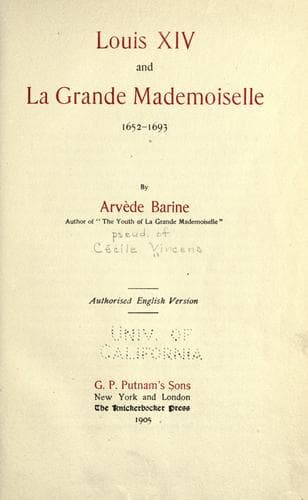
Louis XIV and La Grande Mademoiselle, 1652-1693Barine, Arvède
History
Louis XIV and La Grande Mademoiselle, 1652-1693
Barine, Arvède
Louis XIV, King of France, 1638-1715; Montpensier, Anne-Marie-Louise d'Orléans, duchesse de, 1627-1693
Other serious difficulties arose from the fact of Lauzun considering the
money of Mademoiselle as his own. Choisy appeared to him a useless
expense; he found much fault with its management. "The terraces cost
immense sums," said he one day while walking in the grounds; "what good
are they?" The Princess had sold in his absence a chain of pearls.
"Where is the money?" demanded Lauzun. He wished to hold the purse
strings, and no longer to be a "beggar." It astonished him that
Mademoiselle had not thought of preparing for him, before his arrival,
"a beautiful apartment," of organising his establishment, of placing one
of her carriages at his disposal.
He complained openly in the social world that she left him without a
penny; that she had only given him some diamonds, worth perhaps one
thousand pistoles in all--and what stones, so "ugly"!--and that he had
immediately sold them to obtain means of "subsistence." This is the
perpetual complaint of the youthful husband, who wishes to be
recompensed for the devotion lavished upon an elderly wife. The
"beautiful apartment" existed and awaited him, but it was at the Chateau
of Eu; the King would not tolerate his presence at the Luxembourg.
Those who had the good fortune to visit Eu before the fire of 1902 will
not have forgotten the flight of Loves on the ceiling of a chamber
situated above that belonging to Mademoiselle. The Chamber of the Loves
was the one designed for Lauzun, who failed, however, to honour the
symbol. After a delay of three weeks, he no sooner arrived than he
committed the unpardonable imprudence of running after the village
girls, under the very eyes of Mademoiselle. This was too much. The
mistress of the chateau beat Lauzun, scratched his face, and turned him
out of doors. There he should stay. He was sufficiently shrewd to desire
an accommodation. The Comtesse de Fiesque served as intermediary.
In the Chateau of Eu there was a long gallery filled with family
portraits. Mademoiselle appeared at one end; "he [Lauzun] was at the
other, and he crept along on his knees the entire length of the gallery,
till he reached the feet of Mademoiselle."[304] Possibly they forgave
each other sincerely, but when friction once exists between married
couples it continues, whether in the palace of princes or in the huts of
charcoal burners. Such scenes, more or less stormy, occurred again in
the future. Lauzun grew weary of being beaten, and in his turn used
force with the Princess, and this happened several times. In the end,
disgusted with each other, they fought for the last time and separated,
never to meet again.
Public-domain text, read in full here on John Shaqi.
Reviews
Reviews
No reviews yet
Be the first to share your thoughts on this work.
Elsewhere in the archive
Join the Discussion
Join the discussion
Sign in to leave a comment or review.
Sign InorCreate an account