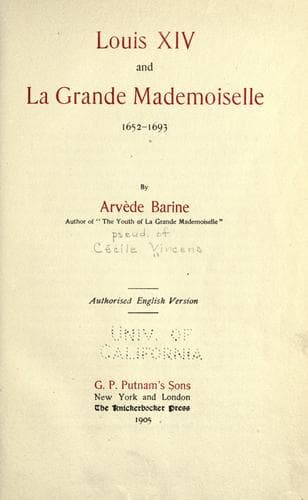
Louis XIV and La Grande Mademoiselle, 1652-1693Barine, Arvède
History
Louis XIV and La Grande Mademoiselle, 1652-1693
Barine, Arvède
Louis XIV, King of France, 1638-1715; Montpensier, Anne-Marie-Louise d'Orléans, duchesse de, 1627-1693
The final quarrel is related in detail in the _Memoires_ of
Mademoiselle. It happened in the spring of 1684. France was at war with
Spain. On April 22d the King departed to join his army, refusing to
permit Lauzun to accompany him, who imagined, rightly or wrongly, that
Mademoiselle was responsible for the prohibition, and was indignant. He
went to the Luxembourg, where a reception of raillery exasperated him
still further:
I met him laughing, and said: "You must retire to
Saint-Fargeau; you will be a laughing stock if you remain at
Paris, as you were not permitted to go with the King, and I
shall be very vexed if it is believed that it is I who have
caused you to remain behind." He replied: "I am going away, and
bid you farewell; I shall never see you again." I said: "It
would have been better if we had never met; but better late
than never." "You have ruined my career," replied he; "you
might as well have cut my throat; it is your fault that I am
not with the King; you asked him to leave me behind." "Oh, that
is false; he will tell you so himself." Lauzun grew more and
more angry, and I remained very calm. I said to him: "Adieu,
then"; and I entered my boudoir. I remained there some time; on
returning, I found him still there. The ladies present said:
"Do you not wish to play cards?" I approached him,
saying: "This is too much; keep your promise;
go away." He finally withdrew.
This rupture made a great scandal. Dangeau, who had followed the King to
the frontier, noted on May 6th, in his journal: "The news comes from
Paris that Mademoiselle has forbidden M. de Lauzun to appear again
before her." Thus ends meanly and miserably, with a scene worthy of
Dickens, the most famous passion of the century, after that of Chimene
and Rodrigue. The first interest in the affair abated, the hero of the
romance sank into obscurity. Mademoiselle cast herself into an ecstasy
of pious devotion, from which the virtue of pardoning the offences of
others was apparently excluded.
Lauzun sought some support to which to attach himself, and did not
easily find it. He realised too late that one could not quarrel with
impunity with a princess of the blood. He made attempts at
reconciliation, which Mademoiselle repulsed; she had loved with too much
ardour not to be capable of furious hate. The career of both lovers
appeared to be finished, when the fantastic star which had guided Lauzun
towards so many adventures, marvellous if not always agreeable, led him
to England during the autumn of 1688. He sought a more hospitable court,
he found a revolution and glory. "I admire the star of M. de Lauzun,"
wrote Mme. de Sevigne, "which again brings its light over the horizon
when it was supposed to be for ever extinguished" (December 24, 1688).
Public-domain text, read in full here on John Shaqi.
Reviews
Reviews
No reviews yet
Be the first to share your thoughts on this work.
Elsewhere in the archive
Join the Discussion
Join the discussion
Sign in to leave a comment or review.
Sign InorCreate an account