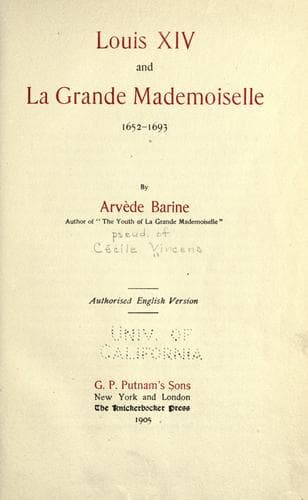
Louis XIV and La Grande Mademoiselle, 1652-1693Barine, Arvède
History
Louis XIV and La Grande Mademoiselle, 1652-1693
Barine, Arvède
Louis XIV, King of France, 1638-1715; Montpensier, Anne-Marie-Louise d'Orléans, duchesse de, 1627-1693
She flattered herself that at the end of "two or three years at
most"[315] she would find herself independent, rich, and, above all, a
duchess, and this idea captivated her. But Lauzun could never be counted
upon. His wife was obliged to endure him for nearly thirty years, passed
in suffering torments from morning till night from the loving husband.
The King had said to the Marechal de Lorges, in learning of the marriage
of his youngest daughter: "You are bold to take Lauzun into your family;
I trust that you may not repent it." Repentance was prompt and bitter.
Mademoiselle was right, it was impossible to live with Lauzun. It was
through miracles of patience that his new wife bore to the end, and
miracles should never be exacted in wedded life. The mean little
calculation at the beginning had been amply expiated by the time that
Mme. de Lauzun finally became a widow. Even to the end, Lauzun had
remained one of the ornaments and curiosities of the Court of France,
noted for his grand manner, the eccentricities of his habits, the
splendour of his habitation, and for the indescribable elegance and ease
of conversation and bearing, which at that time was not to be acquired
at Versailles.
At ninety he himself drove, and sometimes with fiery animals. One day,
when he was training a fresh colt in the Bois de Boulogne, the King,
Louis XIV., passed. Lauzun executed before him a "hundred capers" and
filled the spectators with admiration, by his "address, his strength,
and his grace."[316] He still often enjoyed "pretty" moments. But there
was a reverse side to the medal: the malignant dwarf "frightened all who
approached him with his wicked wit and his hateful tricks." From afar,
Lauzun is very amusing under this aspect; he excelled in buffoonery. In
extreme age, he suffered from a malady which almost killed him. One day,
when he was very ill, he perceived reflected in a mirror the forms of
two of his heirs who entered the chamber on tiptoe, fancying themselves
concealed behind the curtains, to ascertain with their own eyes how long
they were to be forced to wait. Lauzun feigned to perceive nothing and
began to pray in a loud voice as one who believes himself alone. He
demanded pardon of God for his past life, and lamented that his time for
repentance was so short. He exclaimed that there was only a single way
to secure his safety, which was to devote the wealth which God had given
him to paying for his sins, and this he engaged to do with all his
heart. He promised to leave to the hospital all that he possessed,
without abstracting a single penny. He made this declaration with so
much fervour and with so penetrating an accent that his heirs fled away
in despair, to relate the misfortune to Mme. de Lauzun. This scene
properly terminates the career of this extraordinary personage,
unscrupulous and malignant to the last. Lauzun died in 1723, at over
ninety years of age.
Public-domain text, read in full here on John Shaqi.
Reviews
Reviews
No reviews yet
Be the first to share your thoughts on this work.
Elsewhere in the archive
Join the Discussion
Join the discussion
Sign in to leave a comment or review.
Sign InorCreate an account