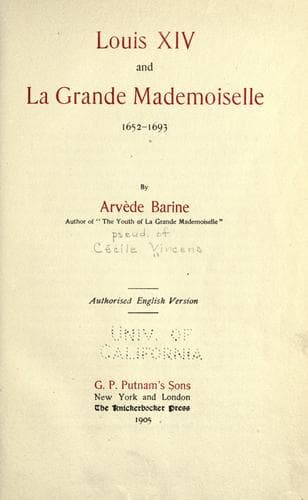
Louis XIV and La Grande Mademoiselle, 1652-1693Barine, Arvède
History
Louis XIV and La Grande Mademoiselle, 1652-1693
Barine, Arvède
Louis XIV, King of France, 1638-1715; Montpensier, Anne-Marie-Louise d'Orléans, duchesse de, 1627-1693
Mademoiselle was the last to disappear of the grand figures belonging to
the time of the Fronde. Retz, Conde, Turenne, La Rochefoucauld, Mme. de
Chevreuse, Mme. de Longueville, had departed before her.
The only one of the ancient rebels which could not perish, the Hotel de
Ville of Paris, had been suppressed from history by royal ordinance for
the period corresponding to the Fronde. The accounts of the prosecutions
of the Council recorded the revolutionary sentiments which prevailed at
the capital during the civil war. The King ordered all the
registers[317] to be destroyed, and the destruction included every
record relating to public affairs for the years 1646-1653.
It may be said without too much calumniating the heart of Louis XIV.
that the death of his cousin afforded a certain relief. She was too
lively a reminder of the execrable period which he did his best to
banish from his own memory as well as from that of the public.
Saint-Simon, newly arrived at the Court at the date of the death of
Mademoiselle, had time to convince himself that she was in the eyes of
the King always the unpardoned and unpardonable heroine of the combat of
the Porte Saint-Antoine. "I heard him reproach his cousin once at
supper, joking it is true, but a little roughly, for having turned the
cannon of the Bastile upon his troops."
The royal rancour extended to the city of Paris, eternal cradle of
French revolutions. Not being able to suppress the capital, Louis XIV.
banished himself from its gates. On May 6, 1682, unfortunate date for
the French monarchy, the Court installed itself definitely at
Versailles, and henceforth left this place only for sojourns at the
various country seats, as Fontainebleau and Marly. Paris was abandoned,
left to do penance. Not only did Louis XIV. desert this city as a place
of residence, but he visited it rarely. It was remarked that he often
made long detours rather than to pass through Paris. The nobility and
ministers followed the King to Versailles. Royalty and the capital
turned their backs on each other.
Another important event influenced the ideas of Court decorum and
propriety. The Queen Marie-Therese dying in 1683 (July 30), Louis XIV.
in the course of the winter following formally married Mme. de
Maintenon. The physiognomy of the Court, what Saint-Simon would have
called the bark (_ecorce_), entirely changed its character. At the
moment of ending this long study it is, then, a different world to which
adieu must be said from the one which was found at the beginning, and
the transformation did not end with the "bark." The principal cause of
the change, the establishment of absolute monarchy, had acted violently
upon France in shaking the nation to its depths, as do all changes not
developing from national tradition.
Public-domain text, read in full here on John Shaqi.
Reviews
Reviews
No reviews yet
Be the first to share your thoughts on this work.
Elsewhere in the archive
Join the Discussion
Join the discussion
Sign in to leave a comment or review.
Sign InorCreate an account