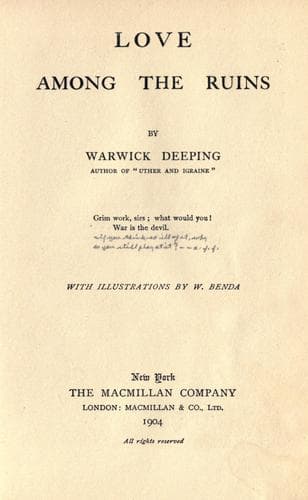
Great Britain -- History -- Medieval period, 1066-1485 -- Fiction; Man-woman relationships -- Fiction
In the east, Godamar the free-lance lay with his troops in Thorney Isle,
closed in and leaguered by the warlike Abbot of Rocroy. The churchman
had seized the dyke-ways of the fens, and had hemmed the rebels behind
the wild morasses. As for the eastern folk, they were poor gizardless
creatures; having faced about, they had declared for the King, and left
Godamar to rot within the fens. The free-lance had enough ado to keep
the abbot out. His marching to join Fulviac was an idle and
strategetical dream.
Last of all, the barons of the north--fierce, rugged autocrats, had
gathered their half-barbarous retainers, and were marching on Lauretia
to uphold the King. They were grim folk, flint and iron, nurtured amid
the mountains and the wild woods of the north. They marched south like
Winter, black and pitiless, prophetic of storm-winds, sleet, and snow.
Some forty thousand men had gathered round the banner of Sir Morolt of
Gorm and Regis, and, like the Goths pouring into Italy, they rolled down
upon the luxurious provinces of the south.
Fortune had decreed that about Lauretia, the city of the King, the
vultures of war should wet their talons. It was a rich region, gemmed
thick with sapphire meres set in deep emerald woods. Lauretia, like a
golden courtesan, lay with her white limbs cushioned amid gorgeous
flowers. Her bosom was full of odours and of music; her lap littered
with the fragrant herbs of love. No perils, save those of moonlit
passion, had ever threatened her. Thus it befell that when the
storm-clouds gathered, she cowered trembling on her ivory couch, the
purple wine of pleasure soaking her sinful feet.
In a broad valley, five leagues south of the city, Fulviac’s rebels
fought their first great fight with Richard of the Iron Hand. A
warrior’s battle, rank to rank and sword to sword, the fight had burnt
to the embers before the cressets were red in the west. Fulviac had
headed the last charge that had broken the royal line, and rolled the
shattered host northwards under the cloak of night. Dawn had found
Fulviac marching upon Lauretia, eager to let loose the lusts of war upon
that rich city of sin. He was within three leagues of the place, when a
jaded rider overtook him, to tell of Malgo’s death and of the battle in
the west. Yet another league towards the city his outriders came
galloping back with the news that the northern barons had marched in and
joined the King. Outnumbered, and threatened on the flank, Fulviac
turned tail and held south again, trusting to meet Godamar marching from
the fens.
He needed the shoulders of an Atlas those September days, for rumour
burdened him with tidings that were ominous and heavy. Godamar lay
impotent, hedged in the morasses; Malgo was dead, his mountaineers
scattered. Sir Simon of Imbrecour was leading in the western lords to
swell the following of the King. Vengeance gathered hotly on the rebel
rear, as Fulviac retreated by forced marches towards the south.
Public-domain text, read in full here on John Shaqi.
Reviews
Reviews
No reviews yet
Be the first to share your thoughts on this work.
Elsewhere in the archive
Join the Discussion
Join the discussion
Sign in to leave a comment or review.
Sign InorCreate an account