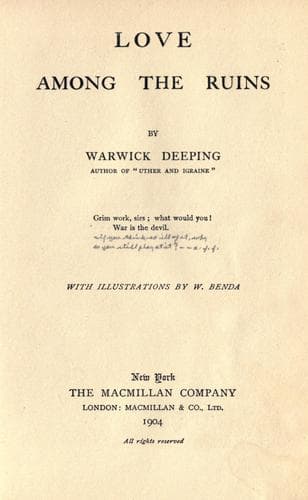
Great Britain -- History -- Medieval period, 1066-1485 -- Fiction; Man-woman relationships -- Fiction
It was at St. Gore, a red-roofed town packed on a hill, amid tall,
dreaming woods, that Colgran, with the ten thousand who had leaguered
Gambrevault, drew to the main host again. Fulviac had quartered a
portion of his troops in the town, and had camped the rest in the
meadows without the crumbling, lichen-grown walls. He had halted but
for a night on the retreat from Lauretia, and had taken a brief breath
in the moil and sweat of the march. His banner had been set up in the
market-square before a rickety hostel of antique tone and temper. His
guards lounged on the benches under the vines; his captains drank in the
low-ceilinged rooms, swore and argued over the rough tables.
It was evening when Colgran’s vanguard entered the town by the western
gate. His men had tramped all day in the sun, and were parched and
weary. None the less, they stiffened their loins, and footed it through
the streets with a veteran swagger to show their mettle. Fulviac came
out and stood in the wooden gallery of the inn, watching them defile
into the market-square. They tossed their pikes to him as they poured
by, and called on him by name--
"Fulviac, Fulviac!"
He was glad enough of their coming, for he needed men, and the rough
forest levies were in Colgran’s ranks. Ten thousand pikes and brown
bills to bristle up against the King’s squadrons! There was strength in
the glitter and the rolling dust of the columns. Yet before all, the
man’s tawny eyes watched for a red banner, and a woman in armour upon a
white horse, Yeoland, wife of Flavian of Gambrevault.
In due season he saw her, a pale, spiritless woman, wan and haggard,
thin of neck and dark of eye. The bloom seemed to have fallen from her
as from the crushed petals of a rose. The red banner, borne by a man
upon a black horse, danced listlessly upon its staff. She rode with
slack bridle, looking neither to the right hand nor to the left, but
into the vague distance as into the night of the past.
Around her tramped Colgran’s pikemen in jerkins of leather and caps of
steel. The woman moved with them as though they were so many
substanceless ghosts, stalking like shadows down the highway of death.
Her face was bloodless, bleached by grievous apathy and chill pride.
The bronzed faces round her were dim and unreal, a mob of masks, void of
life and meaning. Sorrow had robed her in silent snow. The present was
no more propitious to her than a winter forest howling under the moon.
Public-domain text, read in full here on John Shaqi.
Reviews
Reviews
No reviews yet
Be the first to share your thoughts on this work.
Elsewhere in the archive
Join the Discussion
Join the discussion
Sign in to leave a comment or review.
Sign InorCreate an account