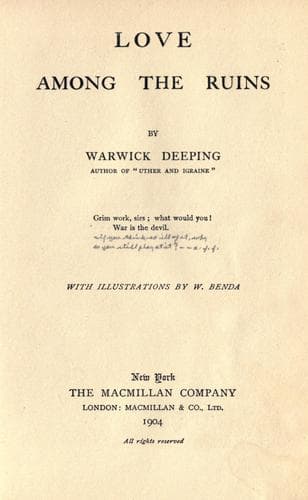
Great Britain -- History -- Medieval period, 1066-1485 -- Fiction; Man-woman relationships -- Fiction
"I am wiser in many ways than you imagine," he said. "Look at me, I am
no longer young; I hate women; I patronise God. You are a mere child;
to you life is dark and perilous as this wilderness of pines. Your
trouble is known to me, because it is my business to know of such
things. It was my deliberate intent that you should fall into my hands
to-day."
The girl was still rigidly astonied. She stared at him mutely with
dubious eyes. The man and his philosophy were beyond her for the
moment.
"Well?" she said to him with a quaver of entreaty.
"First, you will honour me by saying that I have your trust."
"How may I promise you that?"
"Because I am surety for my own honour."
She smiled in his face despite the occasion.
"You seem very sure of your own soul," she said.
"Madame, it has taken me ten years to come by so admirable a state.
Self-knowledge carried to the depths, builds up self-trust. I may take
it for granted that you hate the Lord Flavian of Gambrevault?"
"Need you ask that!"
Her eyes echoed the mood of the flame. Fulviac, watching her, saw the
strong wrack of wrath twisting her delicate features for the moment into
pathetic ugliness.
"You have courage," he said to her.
"Ample, messire."
"Flavian of Gambrevault is the greatest lord in the south."
"I am as wise."
"On that score, this Flavian and Fulviac of the Forest are
irreconcilable as day and night."
The man stood his sword pommel upwards in the grass, and ran on.
"Some day I shall slay this same Flavian of Gambrevault. His blood will
expiate the blood of these your kinsfolk. Therefore, madame, you will
be my debtor."
"That is all?" she asked him with a wistfulness in her voice that was
even piteous.
Fulviac looked long into the fire like a man whose thoughts channel
under the crust of years. Pity for the girl had gone to the heart under
the steel cuirass, a pity that was not the pander of desire. His eyes
took a new meaning into their keen depths; he looked to have grown
suddenly younger by some years. When he spoke again, his voice had lost
its half-mocking and grandiose confidence. It was the voice of a man who
strides generous and eager into the breach of fate.
"Listen," he said to her, "I may tell you that your sorrow has armed my
manhood. Give me my due; I am more than a mere vagabond. You have been
cruelly dealt with; I take your cause upon the cross of my sword."
"You, messire?"
"Even so. I need a good woman, a brave woman. You please me."
"Well?"
"You are a necessity to me."
"And why, messire?"
"For a matter of religion and of justice. Trust to my honour. You
shall learn more in due season."
Yeoland, smitten with incredulity, stared at the man in mute surmise.
Here was an amazing circumstance--robbery idealised, soul, body, purse,
at one bold swoop. In her mystification, she could find nothing to say
to the man for the moment, even though he had promised her a refuge.
"You are very sure of yourself," she said at length.
Public-domain text, read in full here on John Shaqi.
Reviews
Reviews
No reviews yet
Be the first to share your thoughts on this work.
Join the Discussion
Join the discussion
Sign in to leave a comment or review.
Sign InorCreate an account