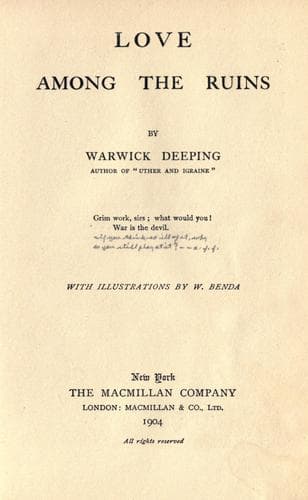
Great Britain -- History -- Medieval period, 1066-1485 -- Fiction; Man-woman relationships -- Fiction
"Am I then so powerful a person?"
"You will learn anon."
"You seem something of a mystic," she said to him.
"Madame," he retorted, "trust my discretion. In due season I shall
unfold to you certain aspects of life that will kindle your sympathies.
I shall appeal to the woman in you. When you are wise you will commend
my ambition."
"You speak in riddles."
"Wait. As yet you see through a glass darkly."
From the mountainous north to the warm southern sea, from the wooded
west to the eastern fens, the good King ruled, holding many great barons
in feudal faith, and casting his fetters of gold over Church and State.
Chivalry moved through the world to the clangour of arms and the songs
of the troubadour. Lutes sounded on terrace and in garden, fair women
bloomed like roses, bathed in a sensuous blaze of romance. Baron made
war upon baron; glory and death were crowned together. The painter
spread his colours in the halls of the great; the goldsmith and the
carver wrought wondrous things to charm the eye. Church bells tolled.
Proud abbots carried the sword, and made fine flutter among the women.
Innumerable saints crowded the avenues to heaven. It was a fair age and
very lovely, full of colour and desire, music and the odour of romance.
And the poor? Their lot hung largely on the humour of an overlord, or
the state of a gentleman’s stomach. They had their saints’ days, their
games, their pageants, their miracle plays. They had hovels of clay and
wattle; labour in wind and rain; plagues and pestilences in the rotting
filth of their city alleys. They marked the great folk go by in silks
and cloth of gold, saw the pomp and opulence of that other life,
remembered their own rags and their squealing children.
And yet, consider the broad inclinations of the world. To eat, to be
warm, to satisfy the flesh, to ease a lust, to drink beer. There was no
very vast gulf betwixt the rich man and the poor. The one feasted to
music, the other scraped a bone to the dirge of toil. They had like
appetites, like satisfactions, and hell is considered to be Utopian in
the extreme. The poor man envied the rich; the rich man ruled the poor.
Envy, that jingling demagogue, has made riotous profit out of such a
stew since the world was young.
Fulviac’s cliff was shut out from the ken of man by leagues of woodland,
moor, and waste. The great pine forest girded it in its inmost bosom.
No wayfarers rode that way; no huntsman ranged so deep; the place had an
evil rumour; many whom it had welcomed had never returned. Romancers
had sung of it, the lay of Guingamor. Horror ruled black-browed over its
pine-cumbered hills, its gloomy depths. Solitude abode there, as over a
primæval sea, and there was no sound save the moan or storm-cry of the
wind over its troubled trees.
Public-domain text, read in full here on John Shaqi.
Reviews
Reviews
No reviews yet
Be the first to share your thoughts on this work.
Join the Discussion
Join the discussion
Sign in to leave a comment or review.
Sign InorCreate an account