Anonyms and pseudonyms -- Fiction; Authorship -- Fiction; Boston (Mass.) -- Social life and customs -- Fiction
Graham took up the tray and departed, his back radiating protest until
the portière dropped behind him. When he was gone Mrs. Harbinger drew
May down to a seat on the sofa, and looked at her steadily.
"You evidently have really something to tell," she said; "and I have an
idea that it's mischief. Out with it."
May drew back with heightened color.
"Oh, I don't dare to tell you!" she exclaimed.
"Is it so bad as that?"
"Oh, it isn't bad, only--Oh, I don't know what in the world you will
think!"
"No matter what I think. I shan't tell you, my dear. No woman ever does
that."
May regarded her with a mixture of curiosity and wistfulness in her
look.
"You are talking that way just to give me courage," she said.
"Well, then," the other returned, laughing, "take courage, and tell me.
What have you been doing?"
"Only writing letters."
"Only! Good gracious, May! writing letters may be worse than firing
dynamite bombs. Women's letters are apt to be double-back-action
infernal-machines; and girls' letters are a hundred times worse. Whom
did you write to?"
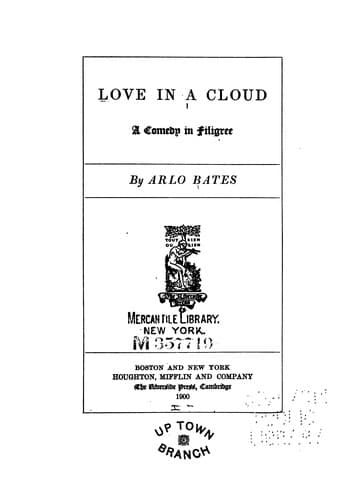
"To the author of 'Love in a Cloud.'"
"To the author of 'Love in a Cloud'? How did you know him?"
Miss Calthorpe cast down her eyes, swallowed as if she were choking, and
then murmured faintly: "I don't know him."
"What? Don't know him?" her friend demanded explosively.
"Only the name he puts on his book: Christopher Calumus."
"Which of course isn't his name at all. How in the world came you to
write to him?"
The air of Mrs. Harbinger became each moment more judicially moral,
while that of May was correspondingly humble and deprecatory. In the
interval during which the forgetful Graham returned with the teacups
they sat silent. The culprit was twisting nervously a fold of her frock,
creasing it in a manner which would have broken the heart of the tailor
who made it. The judge regarded her with a look which was half
impatient, but full, too, of disapproving sternness.
"How could you write to a man you don't know," insisted Mrs.
Harbinger,--"a man of whom you don't even know the name? How could you
do such a thing?"
"Why, you see," stammered May, "I thought--that is--Well, I read the
book, and--Oh, you know, Mrs. Harbinger, the book is so perfectly
lovely, and I was just wild over it, and I--I--"
"You thought that being wild over it wasn't enough," interpolated the
hostess in a pause; "but you must make a fool of yourself over it."
"Why, the book was so evidently written by a gentleman, and a man that
had fine feelings," the other responded, apparently plucking up courage,
"that I--You see, I wanted to know some things that the book didn't
tell, and I--"
"You wrote to ask!" her friend concluded, jumping up, and standing
before her companion. "Oh, for sheer infernal mischief commend me to one
of you demure girls that look as if butter wouldn't melt in your mouths!
If your father had known enough to have you educated at home instead of
abroad, you'd have more sense."
Public-domain text, read in full here on John Shaqi.
Reviews
Reviews
No reviews yet
Be the first to share your thoughts on this work.
Join the Discussion
Join the discussion
Sign in to leave a comment or review.
Sign InorCreate an account