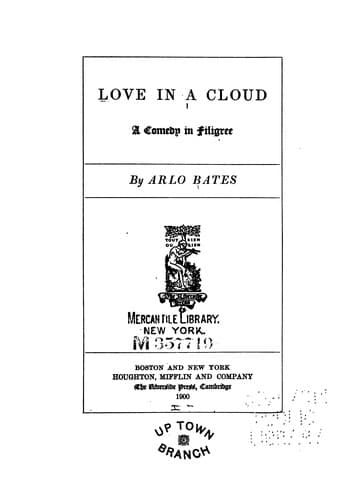
Anonyms and pseudonyms -- Fiction; Authorship -- Fiction; Boston (Mass.) -- Social life and customs -- Fiction
The other set his square jaw the more firmly amid its abundant folds of
flabby flesh.
"Let it pass?" he interrupted with heavy excitement. "If something isn't
done to stop the infernal impudence of these literary scribblers there
will be no peace in life. There is nothing sacred! They ought to be
punished, and I'll follow this rascal if it costs me every dollar I'm
worth. I came to you because I thought you'd sympathize with me."
Mr. Harbinger moved uneasily in his chair like a worm on a hook.
"Why, really, Barnstable," he said, "I feel as you do about the
impudence of writers nowadays, and I'd like to help you if I could;
but--"
The other broke in with a solemn doggedness which might well discourage
any hope of his being turned from his purpose by argument.
"I mean to bring suit for libel, and that's the whole of it."
"Perhaps then," the lawyer responded with ill concealed irritation, "you
will be good enough to tell me whom the suit is to be against."
"Who should it be against? The author of 'Love in a Cloud,' of course."
"But we don't know who the author of that cursed book is."
"I know we don't know; but, damme, we must find out. Get detectives;
use decoy advertisements; do anything you like. I'll pay for it."
Mr. Harbinger shrugged his shoulders, and regarded his client with an
expression of entire hopelessness.
"But I'm not in the detective business."
The other gave no evidence of being in the least affected by the
statement.
"Of course a lawyer expects to find out whatever is necessary in
conducting his clients' business," he remarked, with the air of having
disposed of that point. "There must be a hundred ways of finding out who
wrote the book. An author ought not to be harder to catch than a
horse-thief, and they get those every day. When you've caught him, you
just have him punished to the extent of the law."
Harbinger rose from his chair and began to walk up and down with his
hands in his pockets. The other watched him in silence, and for some
moments nothing was said. At length the lawyer stopped before his
client, and evidently collected himself for a final effort.
"But consider," he said, "what your case is."
"My case is a good case if there is any justice in the country. The man
that wrote that book has insulted my wife. He has told her story in his
confounded novel, and everybody is laughing over her divorce. It is
infamous, Harbinger, infamous!"
He so glowed and smouldered with inner wrath that the folds of his fat
neck seemed to soften and to be in danger of melting together. His
little eyes glowed, and his bushy hair bristled with indignation. He
doubled his fist, and shook it at Harbinger as if he saw before him the
novelist who had intruded upon his private affairs, and he meant to
settle scores with him on the spot.
"But nobody knew that you had a wife," Harbinger said. "You came here
from Chicago without one, and we all thought that you were a bachelor."
Public-domain text, read in full here on John Shaqi.
Reviews
Reviews
No reviews yet
Be the first to share your thoughts on this work.
Join the Discussion
Join the discussion
Sign in to leave a comment or review.
Sign InorCreate an account