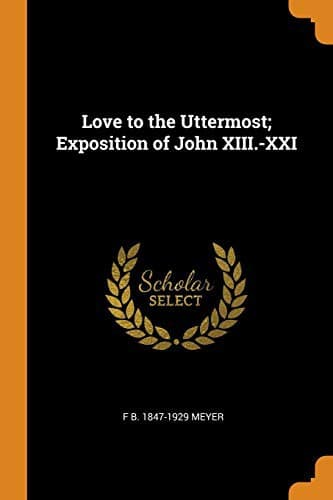
Love to the Uttermost: Expositions of John XIII.-XXI.Meyer, F. B. (Frederick Brotherton)
Religion
Love to the Uttermost: Expositions of John XIII.-XXI.
Meyer, F. B. (Frederick Brotherton)
Bible. John -- Criticism, interpretation, etc.
In order to His death having any value it must be free. If it could be
shown that He had no choice than to die, because His own purpose was
overmastered by the irresistible force of circumstances, His death
could not have met the claims of a broken law, or inaugurated a new
code of morals to His Church. But there are several points in this
narrative which make it clear that He laid down His life of Himself,
that none took it from Him, that He had power to lay it down, and power
to take it again.
(1) When Jesus asked them the question, "Whom seek ye?" there were, no
doubt, many in the band who knew Him well enough, and that He was the
object of their midnight raid; but not one of them had the courage to
answer, "Thee." A paralyzing awe had already commenced to cast its
spell over their spirits. Those who knew Him shrank from identifying
Him, and were content to answer generally, "Jesus of Nazareth." But
when He answered, "I am He," what was it that so suddenly affected
them? Did some stray beams of concealed glory burst forth from their
confinement to indicate His majesty? Did they dread the putting-forth
of that power which had been so often exerted to save and bless? Or,
was there a direct miracle of Divine power, which secured their
discomfiture? We cannot tell. But, whatever the cause, the crowd
suddenly fell back in confusion, and were flung to the ground.
Here, for a moment, the would-be captors lay, as though pinioned to the
dust by some unseen hand. The spell was soon withdrawn, and they were
again on their feet, cursing themselves for their needless panic.
But--and this is the point--the power that sent that rough hireling
band reeling backward to the ground could easily have held them there,
or plunged them as Korah, Dathan, and Abiram, into living graves. "One
flash came forth to tell of the sleeping lightning which He would not
use"; and then, having revealed the might, which could have delivered
Him from their puny arms, He returned to His attitude of willing
self-surrender. Who, then, shall say that our Saviour's death was not
His own act and deed?
(2) When that rabble crew were again on their feet, confronting Jesus,
He asked them a second time, _Whom seek ye_? Again they replied,
"Jesus of Nazareth." Jesus answered, "I have told you that I am He;
if, therefore, ye seek me, let these go their way." And, forthwith, He
put forth such a power over His own as secured their freedom from
arrest.
Public-domain text, read in full here on John Shaqi.
Reviews
Reviews
No reviews yet
Be the first to share your thoughts on this work.
Elsewhere in the archive
Join the Discussion
Join the discussion
Sign in to leave a comment or review.
Sign InorCreate an account