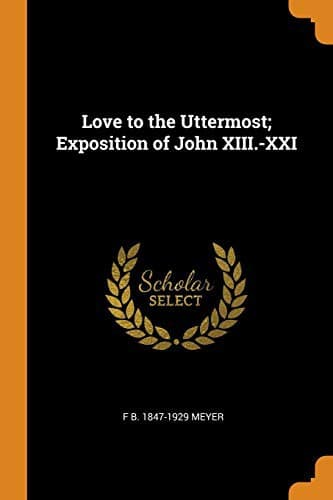
Love to the Uttermost: Expositions of John XIII.-XXI.Meyer, F. B. (Frederick Brotherton)
Religion
Love to the Uttermost: Expositions of John XIII.-XXI.
Meyer, F. B. (Frederick Brotherton)
Bible. John -- Criticism, interpretation, etc.
It was an unwelcome interference with the behavior of the meek and
gentle Lord, whose hand was already bound. It could not be permitted.
"Suffer ye thus far," He said to the rude soldier who was binding Him,
and with His own finger touched the ear, stanched the flowing blood,
and healed it. It has been remarked that this was the only act of
healing wrought on one for whom it was neither asked of Him, and who
had no faith in His beneficent power. But, surely, the hand that could
work that miracle could have broken from the bonds that held it as
easily as Samson from the two new cords which burned as flax in the
flame. The power with which Jesus saved others might have saved
Himself. Who, then, shall say that His death was not His own free act?
Listen, moreover, to His own words. Then said Jesus unto Peter, "Put
up thy sword into the sheath; the cup which My Father hath given Me,
shall I not drink it?" "Thinkest thou that I cannot now pray to My
Father, and He shall presently give Me more than twelve legions of
angels; but how then shall the Scripture be fulfilled that thus it must
be?"
As, then, we view the death of the Cross we must ever remember the
voluntariness of that supreme act, which is all the more conspicuous as
the agony of the Garden reminds us how greatly the Lord's spirit
dreaded the awful pressure of the world's sin, which made Him cry: "My
God, My God, why hast Thou forsaken Me?" How greatly He must have
loved us! It was love, and only love, that kept Him standing at the
bar of Pilate, bending beneath the scourge of the soldiers, hanging in
apparent helplessness on the cross. Not the iron hand of relentless
fate; not the overpowering numbers or closely-woven plots of His foes;
not the nails that pierced His quivering flesh. No, it was none of
these. It was not even the compulsion of the Divine purpose. It was
His own choice, because of a love that would bear all things if only it
might achieve redemption for those whom He loved more than Himself.
"He loved me, and gave Himself for me."
Surely we may trust that love. If it moved Him to endure the Cross and
despise the shame, is there anything that it will withhold, anything
that it will not do? His love is stronger than death, and mightier
than the grave. Strong waters cannot quench it, floods cannot drown
it. It silences all praise, and beggars all recompense. To believe
and accept it is eternal life. To dwell within its embrace is the
foretaste of everlasting joy. To be filled by it is to be transfigured
into the image of God Himself.
XXIV
Drinking the Cup
"The cup which My Father hath given Me, shall I not drink it?"--JOHN
xviii. 1-14.
Public-domain text, read in full here on John Shaqi.
Reviews
Reviews
No reviews yet
Be the first to share your thoughts on this work.
Elsewhere in the archive
Join the Discussion
Join the discussion
Sign in to leave a comment or review.
Sign InorCreate an account