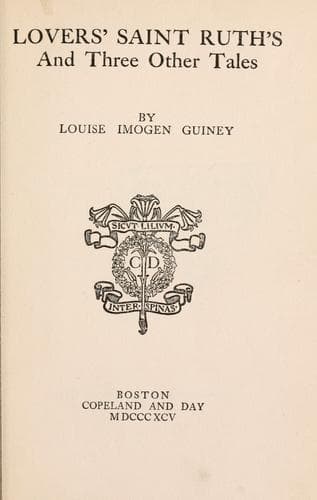
Lovers' Saint Ruth's, and Three Other TalesGuiney, Louise Imogen
General
Lovers' Saint Ruth's, and Three Other Tales
Guiney, Louise Imogen
American fiction -- 19th century; Short stories, American
musty parchments, he did not know but what I had best have this one,
especially as his wife and niece, having glanced at it, would not give
it house-room! So I had the keepership of that mournful secret of the
Lord Richard's wonderful love and patience, which came near altering
the local annals I was to write. It was like the unburied dead; it
tormented me. Not one of those vulgarians to whom it really belonged
was fit to touch it, much less understand it; and I did not wish to add
it to any collection, mine or another's. I hesitated a good bit, and
then I stole off, on a chilly Martinmas eve, and piously burned it here
in Lovers' Saint Ruth's, on this tomb, and scattered the ashes into the
grass." A gust of wind came into the choir, and the clock half a mile
away struck one. At the sound, we reached for our hats, which we had
instinctively laid aside, and crossed the little transept to the door,
Nasmith first, I following, as we had entered. Once more, as we left
the porch, dark with ivy and weather-stains, we heard the wood-doves,
over our heads in the nave, utter a slow musical moan, one to the
other. "Their souls," I whispered suddenly. "Peace to all such, after
pain," said poetic Cyril. "_Amen_," I answered. We both smiled. How we
two were enjoying our renewed society, back in a bygone England!
Hardly had we gained the road, when a carriage rolled by, with a
single figure on horseback clattering alongside. A black-bonneted
girl in mourning, handsome, if furtive, under her parasol, and both
her companions, the younger of whom sat beside her, saluted Nasmith
in what I thought to be a cold, perfunctory manner. I guessed
something, for his honest cheek flushed. "I fear these are the great
folk of Orrinleigh," I remarked. "The men have selfish, stupid faces,
more's the pity." "Yes," he replied; "you have seen some of the Lord
Richard's degenerate descendants. I once meant to give his manuscript
to Audrey--to the young lady in the carriage. I hoped she might value
it. But, as I said, I destroyed it instead. You are the only person to
whom I ever repeated the tale, and almost in the original words. Go put
it in a book, if you like, Holden; make what you can of it; develop
and proportion it; I trust your handling." I thanked him. "No. Your
chivalrous Cavalier is too complex a subject for me," was my frank
reply; "I feel safer with a history than with a mystery." I was a
hardened republican novelist even then, and his senior, and not blind
to the "human document," neither of the seventeenth century, nor of the
nineteenth. "Nasmith," I began cunningly, "you were in love with the
Honorable Audrey, and she refused you. How fortunate for you! Yours was
the neatest and most spiritual revenge I ever heard of: to keep from
her what might have helped transform her woman's nature, stifled in an
ill atmosphere,--the knowledge that she was of the blood of the saints,
'Tho' fallen on evil days,
On evil days tho' fallen, and evil tongues.'"
Public-domain text, read in full here on John Shaqi.
Reviews
Reviews
No reviews yet
Be the first to share your thoughts on this work.
Join the Discussion
Join the discussion
Sign in to leave a comment or review.
Sign InorCreate an account