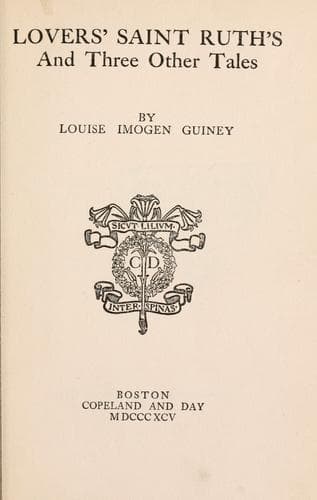
Lovers' Saint Ruth's, and Three Other TalesGuiney, Louise Imogen
General
Lovers' Saint Ruth's, and Three Other Tales
Guiney, Louise Imogen
American fiction -- 19th century; Short stories, American
happened, was true enough; and, moreover, the girl herself had followed
her lover back into the old religion: so that there were disadvantage
and danger of all kinds, in those days, behind them and before. The
little church meant much to them both, the pathetic ghost of what had
been so famous and fair. There they used to meet, when luck served, for
what great comfort they could still reap out of their narrowing lives,
shedding tears on each other's breasts over that outlook which seemed
so cruelly hopeless. But a terrible tragedy broke up and changed their
youth, and it was at Lovers' Saint Ruth's that it happened.
"Eleanor was barely past eighteen, and Richard not one-and-twenty. It
was spring twilight, when he rode down alone to the valley, galloping,
because, for once, he was a little late to meet his maid. She also had
started on foot, across the dewy field-path from Frambleworth, having
for company part of the way an old market-woman and her goodman, who
would not have betrayed the object of her journey for worlds. They
left her at the lonely cross-roads, whence she gayly took her way
west, with Orrinleigh Church, as it was still called, almost in sight.
The next morning their bodies were found, not fifty rods away; and it
is clear to me, that, hearing Eleanor's first stifled call, they had
turned back to her rescue, and so perished at the hands of the wicked.
With whom the guilt lay, none ever knew; the blame was laid upon the
gypsies, I think unjustly, and three of them were hanged on these very
downs. It was a wild time; and desperate men, singly, or in bands,
mad for food and plunder, and reeling drunk from cellar to cellar,
were over this peaceful county. The squire's ewe lamb, whom, in his
senses, a devil might have spared with a blessing on her sweet looks,
was foully waylaid, and worse than murdered. In the face of agony and
humiliation, her spirit fainted away. Hours later, when all was still,
and the dazzling moon was up over the sycamores, Eleanor Thurlocke
awoke, and, with her last spasmodical strength, dragged herself to the
end of the lane, and on to the hollow stone step of the church, to die.
It was past midnight. Who should be within those crumbling walls, even
then, but her own Richard, kneeling in his satin dress, with a lighted
hand-lamp by his side, his brow raised to Heaven? He had missed her;
and he knew not what to think for disappointment and anxious love;
and, sleep being far from him, there had he waited until now before
the fallen altar-stone where they had so often prayed together. As
dejectedly he swung back the outer door, he saw his dear, her thick
gold locks unbound, her vesture in disorder, her hands chilled and
bleeding from the stony travel and the briers. Without a question, for
he was ever a ready courageous lad, he put out the lantern, and cast
it under a bush; and, gathering Eleanor into his strong arms, first
making the sign of the cross upon her brow, he climbed the hill slowly,
Public-domain text, read in full here on John Shaqi.
Reviews
Reviews
No reviews yet
Be the first to share your thoughts on this work.
Join the Discussion
Join the discussion
Sign in to leave a comment or review.
Sign InorCreate an account