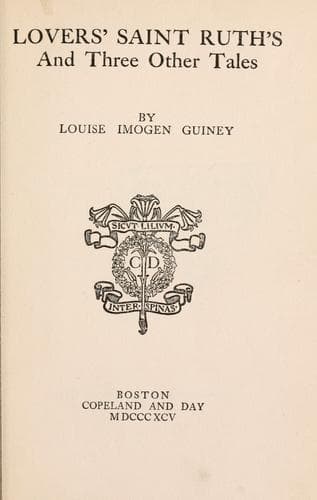
Lovers' Saint Ruth's, and Three Other TalesGuiney, Louise Imogen
General
Lovers' Saint Ruth's, and Three Other Tales
Guiney, Louise Imogen
American fiction -- 19th century; Short stories, American
NORA cried out: "'Tis so pretty to-day!" The barefooted children were
threading the slopes of Howth towards Raheny. Far-off, the city, with
its lights and stretches of glorified evening water, was lying there
lovely enough between the mountains and the sea. It was Nora's tenth
birthday, and, to please her, they had been on the march all afternoon,
their arms full of rock-born speedwell and primrose. "'Tis so pretty!"
echoed little Winny, with enthusiasm. But the boy looked abroad without
a smile. "'T'd be prettier when things is right," he answered severely.
Hughey was a man of culture; but his speech was the soft slipshod of
the south. The three trudged on in silence, for Hughey was a personage
to his small sisters; and Hughey in a mood was to be respected. He,
alas, had been in a mood too long. He had carried Winny over the
roughest places, and shown her Ireland's Eye, and, alongshore, the
fishing-nets and trawls; he had given his one biscuit to be shared
between them all; and lying in the velvet sward by the Druid stone, he
had told them all he knew of the fairy-folk in their raths, for the
seventieth time. But he was full of sad and bitter brooding the while,
thinking of his mother, his poor mother, his precious mother, working
too hard at home, for whom there never seemed to be any birthdays or
out-of-door pleasures.
Hugh was nearly twelve now, and mature as the eldest child must
always be among the poor. He could remember times in the county
Wexford, before his father, who was of kin to half the gentry in the
countryside, died; times when life had a very different outlook, and
when his peasant mother, with short skirts and her sleeves rolled
up, would go gayly between her great stone-flagged kitchen and the
well or the turkey-hen's nest under the blackthorn hedge, singing,
singing, like a lark. They had to leave that pleasant farm, and the
thatched roof which had sheltered them from their fate, and move up to
cloudier Dublin, to a stifling garret over a beer-shop; and it was a
miserable change. Malachi O'Kinsella, the cheerful thriftless man, with
his handsome bearing and his superfluous oratory, was gone; and his
Hughey was too young to be of service to those he left behind. A fine
monument, with _Glory be to God_ on it, had to be put up over him in
the old churchyard, two years ago; and there had been since the problem
of schooling, feeding, and clothing Hughey, Nora, and Winny. Then Rose,
three years old, fell into a lime-kiln, and was associated with the
enforced luxury of a second funeral; and Dan, the baby, born after his
father's death, was sickly, and therefore costly too; and now the rent
had to be paid, and the morrow thought of, on just nothing a week! All
of which this Hugh, with his acumen and quick sympathy, had found out.
He worshipped his mother, in his shy, abstinent Irish way; his heart
was bursting for her sake, though he but half knew it, with a sense of
the mystery and wrong-headedness of human society.
Public-domain text, read in full here on John Shaqi.
Reviews
Reviews
No reviews yet
Be the first to share your thoughts on this work.
Join the Discussion
Join the discussion
Sign in to leave a comment or review.
Sign InorCreate an account