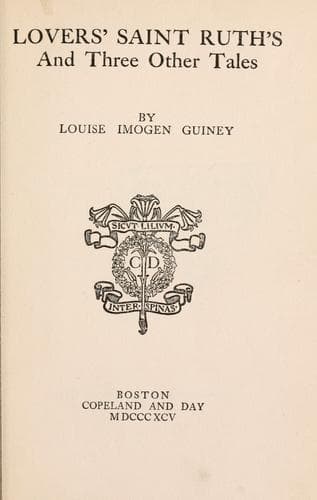
Lovers' Saint Ruth's, and Three Other TalesGuiney, Louise Imogen
General
Lovers' Saint Ruth's, and Three Other Tales
Guiney, Louise Imogen
American fiction -- 19th century; Short stories, American
The junk-man, good-naturedly scanning Hughey, saw him burst into
tears, and beat the air, though the giant of the law had passed on.
That his chief and most secret sin should be mentioned aloud, to
prejudice the world of commerce against him, was horrible. His mother
had told on him! She must have found some lines on Winny's slate last
Sunday, entitled _Drumalough: a Lament for the Fall of the Three
Kings, Written at Midnight._ Worra, worra! Hughey was descended, on
the paternal side, through a succession of ever-falling fortunes, from
a good many more than three kings, and used to wonder where their
crowns and sceptres were, not that he might pawn them, either. The
O'Kinsellas were a powerful aboriginal sept in the old days, and lived
in fortress castles, and playfully carried off cattle and ladies from
their neighbors of the Pale. Malachi O'Kinsella's mother, a heroine of
romance who ran away with a jockey lover, and never throve after, was
of pure Norman blood, and most beautiful, with gray eyes, water-clear,
like Hughey's own, and the same bronze-colored hair; and it was said
she could play the harp that soft it would draw the hearing out of
your head with ecstasy! Now the junk-man was fatherly, and presented
Hughey, in default of a situation, with a consolatory coin; but
foregoing events had been too trying for the boy's nerves: he dropped
it, and fled, sobbing. He simply couldn't live where his po'try was
going to rise up against him, and wail like a Banshee in the public
ear. He charged, in his wrath and grief, across the crowded bridge, and
down the line of quays east of it, straight into a fat, gray-headed,
leather-aproned person directing a group of sailors unloading a boat.
This person, sent of Heaven, with miraculous suddenness, and with
musical distinctness, exclaimed: "'Aven't I been a-wishin' of 'im, and
directly 'e runs into me harms! Crawl into that barrel, sonny, and if
you 'old it steady, I'll 'eave you tuppence." Hughey, foreordained
likewise, crawled in. When he came out, Mr. J. Everard Hoggett looked
him over, from his moribund hat to his slight patrician ankle. "I
likes a boy wot's 'andy, and 'as little to sy, like you." He resumed
critically, "'E don't appear to be from any of 'Er Marjesty's carstles,
'e don't. Perhaps 'e might like to 'ang about 'ere, and earn three bob
a week?" Hughey hugged his twopenny piece, blushed, trembled, twisted
his legs in the brown trousers too big for him, and replied in gulps:
"O sir! Yes, sir." Whereby his annals begin.
This perfectly amazing luck befell towards the end of May. Mr. Hoggett,
going home, beckoned him, took him into a little eating-house, sat
him down, paid for a huge order, and departed. "There's a couple o'
lion cubs hinside wot ought to be your westcot, needs 'am and heggs.
Fill 'em full; and mind you come to-morrow at a quarter to ight. I'll
'ave no lyzy lubbers alongside o' me." With which fierce farewell, and
disdaining thanks, Mr. Hoggett faded wholly away.
Public-domain text, read in full here on John Shaqi.
Reviews
Reviews
No reviews yet
Be the first to share your thoughts on this work.
Join the Discussion
Join the discussion
Sign in to leave a comment or review.
Sign InorCreate an account