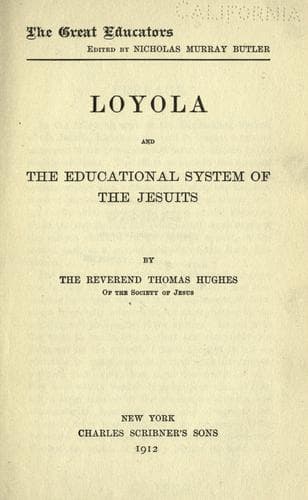
Loyola and the Educational System of the JesuitsHughes, Thomas
History
Loyola and the Educational System of the Jesuits
Hughes, Thomas
Education -- History; Ignatius, of Loyola, Saint, 1491-1556; Jesuits
are of the proper age, and who have the requisite facility in point of
talent, that they should endeavor to advance and become conspicuous
in all."[181] During all this course of higher natural sciences, some
attention has still been paid to accessories; literature has not been
entirely neglected; oratory has been practised, and poems presented on
stated occasions. And then the new Master is introduced into his course
of "regency."
CHAPTER XII.
YOUTHFUL MASTERS.
When Ignatius of Loyola was governing the Society, the multiplicity
of affairs which he had to administer, and the absorption of mind
which they demanded, did not prevent him from devoting to every minute
element the attention which it specially invited. Hence he required
the young Scholastics, who were reviewing their literary studies at
Valencia, to send him their orations and a poem. So, too, with the
Masters of the lower classes at Messina, in Sicily. This college had
opened with the higher courses of letters; but the very next year such
numerous throngs of younger boys came asking for admission, that the
system, begun with Rhetoric and Humanities, was carried down to meet
their needs; and the entire course was distributed into five grades.
Ignatius required the teachers of these lower grades, no less than
those of the higher, to write each week, and send him an account of the
affairs of his class.[182]
It is indeed an eventful moment, when a man becomes a teacher of
others. They may be boys. But, whether they are boys merely blossoming
into life, or youths on the verge of manhood, the teacher of them has
to be a teacher of men; and perhaps more so with the boy than with the
man, inasmuch as his control of the younger student has to be so much
the more complete. It is not merely such a control as will address the
intellects of men mature, whose characters are already far advanced
in the way of formation, or are perhaps fixed for life; but it must
be such as will form a whole human nature, which is still pliable and
docile.
As an almost universal rule, the Jesuit Scholastic, after his course
of Philosophy, takes his place in a college to teach Grammar or
Literature. If it be asked, why should this be an almost universal
rule, several reasons are at hand. In the first place, the candidate
for admission into the Order has been accepted with special reference
to this work. If this reference was expressly overlooked, the candidate
so admitted is in an exceptional category. In the second place, the
whole tenor of what has to be said in the present chapter will show the
pedagogical policy in the arrangement. But, in the third place, not to
pass over too summarily one special fitness, I will say a few words
upon it at once.
Public-domain text, read in full here on John Shaqi.
Reviews
Reviews
No reviews yet
Be the first to share your thoughts on this work.
Elsewhere in the archive
Join the Discussion
Join the discussion
Sign in to leave a comment or review.
Sign InorCreate an account