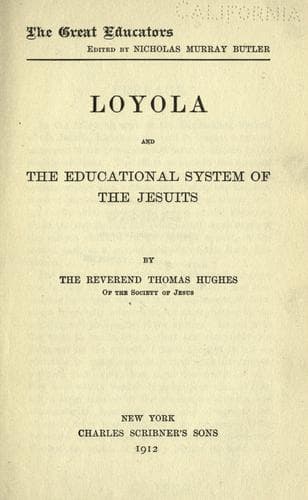
Loyola and the Educational System of the JesuitsHughes, Thomas
History
Loyola and the Educational System of the Jesuits
Hughes, Thomas
Education -- History; Ignatius, of Loyola, Saint, 1491-1556; Jesuits
It is remarked that to the Order was due the multiplication of
observatories, in the middle of last century. Father Huberti
superintended the building of an observatory at Würzburg; Father
Maximilian Hell, the court astronomer, built one at Vienna. At Manheim,
a third was erected by Mayer and Metzger; at Tyrnau, one by Keri; at
Prague, another by Steppling; one at the Jesuit College of Gratz;
similarly at Wilna, Milan, Florence, Parma, Venice, Brescia, Rome,
Lisbon, Marseilles, Bonfa. In short, Montucla remarks: "In Germany
and the neighboring countries, there were few Jesuit colleges without
an observatory. They were to be found at Ingolstadt, Gratz, Breslau,
Olmütz, Prague, Posen, etc. Most of them seem to have shared the fate
of the Society; though there are a few which survive the general
destruction."[180]
These few indications go to illustrate the pedagogical epochs made
by the system of the Order. And the young member, who is being
formed to contribute his own share towards carrying on the education
of the world, passes all these branches under review. One of them,
Mathematics, is conducted outside of the philological seminary,
which we have so far been considering; it is left for his course of
Philosophy, which he will pursue during three years, before actually
embarking on the life of the class-room, or his "regency." We may now
suppose that the time has arrived for his entering the class-room, as a
Master of Grammar and Elementary Literature.
When he does so, he has possessed himself, in that philosophical
triennium, of positive intellectual attainments, neither meagre
nor common. He has surveyed the whole field of natural thought and
investigation, in the various branches, mental, physical, and ethical.
To enumerate them, there is Logic, including dialectics, and the
criteria, objective and subjective, of truth; Ontology, or general
metaphysics; Special Metaphysics, in its three divisions:--Cosmology,
which immediately underlies physics, chemistry, and biology;
Psychology, which underlies all the anthropological sciences about
the human compound, its principles, and the formation of its ideas;
Natural Theology. All this is theoretic or speculative philosophy.
There is besides the science of moral life, which comprises Ethics,
Natural Right, and Social Right. Concurrent with Philosophy, there
has been a double course of Physics and Chemistry, during one year,
with a course of higher Mathematics, varying from one year to three;
as well as a half-year's course of Geology, Astronomy, and some other
subsidiary matters. This is the general formation. The principle which
guides individual cases was laid down by Ignatius in these terms: "In
the superior faculties, on account of the great inequality of talents
and age and other considerations, the Rector of the University will
consider how much in each line individuals shall learn, and how long
they shall stay in the courses; although it is better for those who
Public-domain text, read in full here on John Shaqi.
Reviews
Reviews
No reviews yet
Be the first to share your thoughts on this work.
Elsewhere in the archive
Join the Discussion
Join the discussion
Sign in to leave a comment or review.
Sign InorCreate an account