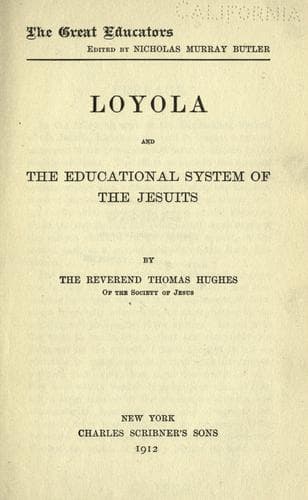
Loyola and the Educational System of the JesuitsHughes, Thomas
History
Loyola and the Educational System of the Jesuits
Hughes, Thomas
Education -- History; Ignatius, of Loyola, Saint, 1491-1556; Jesuits
THE COURSES OF DIVINITY AND ALLIED SCIENCES. PRIVATE STUDY. REPETITION.
1. Having finished his course of teaching literature, the Jesuit
returns to his higher studies. Divinity and its allied sciences stand
out in prominence for their intrinsic dignity; but they have, besides,
a studied preëminence assigned them in the system before us. The almost
universal rule, of intermitting the higher studies with a course of
literary teaching, undergoes a special exception in the case of those
"theologians, whose number is few, and use so manifold";[206] of whom
Aquaviva says that, "according as the higher courses are developed,
the fewer proportionately, out of many students, become qualified
to profess those exalted sciences."[207] The same policy holds with
respect to those who have an eminent talent for oratory. Laynez,
himself a great preacher, and a competent judge in the matter, relieved
Father Francis Strada of the office of Provincial, to set him free for
the ministry of the pulpit; and he wrote, as he did so: "If only he had
a sufficiency of those whom he could put in the office of Provincial,
he would relieve all preachers of that office, that they might devote
themselves entirely to spreading the seed of the Divine Word."[208]
Of these and others, "who give eminent promise of being equal to the
graver occupations, or for whom an immediate need exists in that
direction,"[209] an immediate application is to be made to the study of
Theology.[210]
All who graduate in these higher courses do so, as "qualified to
profess"; just as they had graduated in Philosophy and its cognate
branches.[211] But, though a master in the matter of his philosophical
triennium, no student is called upon to profess any of those branches,
until he has graduated also in Theology. Here we may advert to
several lines of strict parallelism in the system, both with regard
to admitting any students, whether Jesuits or not, to the respective
courses of study, and with regard to admitting Jesuits themselves to
profess in the chairs.
As a condition for admitting any students at all into the higher
courses, the Society introduced a much-needed reform, in requiring that
literary qualifications of a sufficiently high grade should precede
matriculation. Thus the University of Ingolstadt ordains that no one
shall be admitted to Academic, that is, University lectures, except
after one year of Rhetoric; and it adds very strict regulations about
the election of courses, repetitions, disputations, etc., in the three
years' curriculum of Philosophy.[212]
Public-domain text, read in full here on John Shaqi.
Reviews
Reviews
No reviews yet
Be the first to share your thoughts on this work.
Elsewhere in the archive
Join the Discussion
Join the discussion
Sign in to leave a comment or review.
Sign InorCreate an account