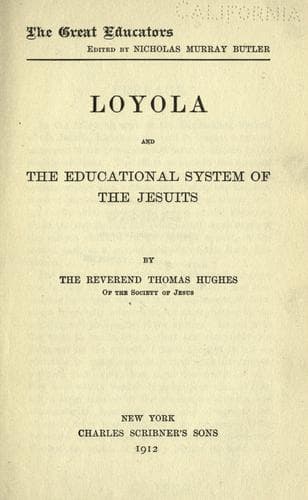
Loyola and the Educational System of the JesuitsHughes, Thomas
History
Loyola and the Educational System of the Jesuits
Hughes, Thomas
Education -- History; Ignatius, of Loyola, Saint, 1491-1556; Jesuits
A second consequence of the literary cast, marking the whole Order,
is the vantage-ground on which it placed the Jesuits, with regard to
all the learning and the learned men of Europe. The fluent and elegant
command of the Latin language gave at once a mastery over the vehicle
of intercourse, in which all learning was conveyed. Our critics of
1586 sum up the bearings of this particular advantage under several
heads: The members of the Order deal with so many nations; scholastic
disputations, whether in Philosophy or Theology, are always conducted
in Latin; the members write so many books; they can do justice to
the ancient Fathers of the Church; they have to deal constantly with
learned men.[203]
A last consequence, which I shall present, is suggested by an
observation of the same writers, in the same place. It throws no little
light upon the history of the Society, and it shows the practical
adjustment of the educational system to the times. They say then,
it is by the studies of Belles-Lettres, more than by the higher
faculties, that the Society has, in a short time, been propagated
through all the principal parts of Christendom. Nor can it be preserved
better or more solidly, than by the same means through which it was
first introduced. Unless they endeavor to maintain this honorable
distinction, with which God has been pleased to grace the Society,
there is reason to fear that they themselves may yet lapse into the
barbarism, which they are far from admiring in others. "As to the
other faculties, which are brilliant enough of themselves, there is
no trouble in cultivating them. But, natural inclinations feeling a
repugnance for less conspicuous pursuits, people have, as it were, to
drag themselves to these lower faculties. They should take lesson,
therefore, by good husbandmen, who bestow more care on transplanted
and exotic growths than on native shoots."[204] And they proceed to
quote the rule, formulated in the words of Ignatius, by the General
Everard Mercurian, who required the institution and preservation of
the literary seminary.[205] So that we end here this discussion on the
lower faculties, at the point where we began.
In all well-assorted plans each element has a reference to every other.
Men must match the work, and the work be suited to the men. Were the
men not formed, the best system would settle into an inert state; and,
the more consistency and vitality of its own it offered to contribute,
the more inept and inert would it look, a memorial of what it might do,
dead to what it can. In itself, and in its effects, it might appear to
be out of date, as not being understood. Only the practical working of
a thing, by the man who understands it, shows it off for what it is
worth. This is a rule quite universal, wherever practical insight is
needed for the working of a mechanism. It must be worked intelligently
to be understood. Once it is understood, the practical intelligence
grows.
CHAPTER XIII.
Public-domain text, read in full here on John Shaqi.
Reviews
Reviews
No reviews yet
Be the first to share your thoughts on this work.
Elsewhere in the archive
Join the Discussion
Join the discussion
Sign in to leave a comment or review.
Sign InorCreate an account