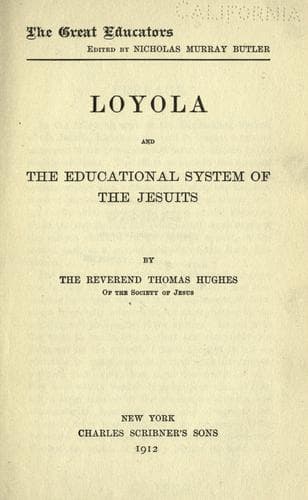
Loyola and the Educational System of the JesuitsHughes, Thomas
History
Loyola and the Educational System of the Jesuits
Hughes, Thomas
Education -- History; Ignatius, of Loyola, Saint, 1491-1556; Jesuits
The branches of this theological course are Scholastic Theology,
Moral Theology, Sacred Scripture, Hebrew and Oriental Languages,
Ecclesiastical History, and Canon Law. The general category of students
is naturally more limited than in the philosophical curriculum. There
the auditors were young men, who would betake themselves, at its
close, to Medicine, or other walks of life. They may have taken to Law;
though Possevino, himself eminent in jurisprudence, would seem to imply
that Canon Law must have been pursued first.[218] The students now are
chiefly Ecclesiastics, with various careers before them; or they are
Religious of different Orders; or, finally, the members of the Society
itself. The principal object of our consideration is the formation of
these latter, as qualified to profess. The pedagogical elements before
us may be ranged under three heads: Private Study; Repetition, which
includes Disputation; Lecturing, which is supplemented by Dictation.
2. As to the method of private study, all the auditors of the course
are directed to look over, prior to the lecture,[219] the text
in Aristotle, St. Thomas, etc., which the Professor is about to
explain.[220] Then, while the lecture is being delivered, they take
down notes; the copying of mere dictation is not favored. After the
lecture, they are to read over the notes which they have taken down.
Let them endeavor to understand their annotations. Understanding what
they have written, they are to make objections to themselves against
the thesis established, and endeavor to solve their own objections.
If they cannot find a solution, let them note the difficulties, and
take occasion to ask the Professor, or reserve them for disputation.
Such is the method of private study prescribed for the members of
the Order,[221] and laid down in more general terms for the other
students.[222] To develop habits of such study, and to afford the
requisite leisure, a certain custom, then prevailing in Portugal, of
keeping the Professors of Philosophy and their students during two
hours and a half consecutively in the lecture room is discountenanced
by the critics of 1586: "That the philosophers should remain two
whole hours and a half in class, as is now done, is burdensome to the
Professor and troublesome to the students; for these latter should get
accustomed to private study, lest, like parrots, they seem to be always
talking by rote."[223]
Public-domain text, read in full here on John Shaqi.
Reviews
Reviews
No reviews yet
Be the first to share your thoughts on this work.
Elsewhere in the archive
Join the Discussion
Join the discussion
Sign in to leave a comment or review.
Sign InorCreate an account