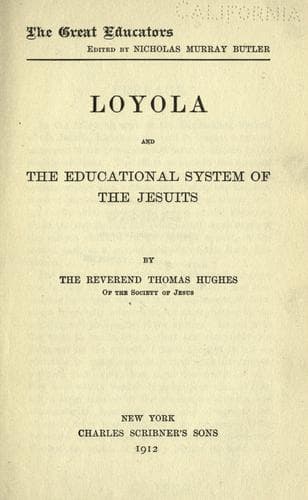
Loyola and the Educational System of the JesuitsHughes, Thomas
History
Loyola and the Educational System of the Jesuits
Hughes, Thomas
Education -- History; Ignatius, of Loyola, Saint, 1491-1556; Jesuits
This curtailing of class hours was characteristic of the Society's
system. In 1567 the General Father Francis Borgia wrote, through his
secretary Polanco, correcting, in this respect, a school-regulation
which had been followed in the lower classes of the German Province.
The secretary writes: "It is found by experience, in the schools of the
Company, that to teach three consecutive hours in the forenoon, and
three more in the afternoon, is injurious to the health of our Masters,
and does no good to the health of the scholars; for which reason it is
now ordained that in our schools the morning classes shall not last
longer than two and a half hours, and the same in the afternoon."[224]
Nothing intensifies more the results of studies than concentration, nor
dissipates them more than division of attention, while a given pursuit
is in progress. This principle applies to the number of courses taken
up at one time, the conduct of private studies in any single course,
and the degree to which the appointed teachers and the standard authors
have full justice done them. On this head, the critics of 1586 give
recommendations, derived from the Constitution, for the direction
of all the students in general, and for the members of the Order in
particular. The recommendations are embodied briefly in the _Ratio
Studiorum_.[225] With Aristotle in Philosophy, or with St. Thomas in
Theology, one commentary is to be designated, and that a specially
chosen author, suited to the individual's capacity. In the second year
of Theology, one of the Fathers of the Church can be added, "to be
read at odds and ends of time, or after the fatigue of a long stretch
of study. Another can be substituted, if after a while they ask for
another. But care should be taken that they do not spend too much time
on this reading, as if they were getting up a sermon."[226]
All this, no doubt, tends to make the student "a man of one book," who,
as the adage says, is much to be feared. However, when he goes through
every course, and is everywhere a man of concentrated attention, while,
for the purpose of public disputation and the attempted refutation of
his own and the Professor's conclusions, the side avenues of various
authors and systems are studiously and necessarily kept open, it is
probable that, after being "a man of one book," in many courses
successively, he will also be well-rounded by the time his formation
is complete. With students in general, this can be accomplished by
the age of twenty-five; with the Jesuits themselves, about the age of
thirty-three.
Public-domain text, read in full here on John Shaqi.
Reviews
Reviews
No reviews yet
Be the first to share your thoughts on this work.
Elsewhere in the archive
Join the Discussion
Join the discussion
Sign in to leave a comment or review.
Sign InorCreate an account