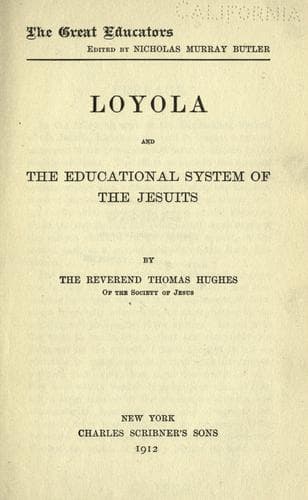
Loyola and the Educational System of the JesuitsHughes, Thomas
History
Loyola and the Educational System of the Jesuits
Hughes, Thomas
Education -- History; Ignatius, of Loyola, Saint, 1491-1556; Jesuits
Secondly, the student hears the Professor's lecture. Thirdly, one of
the forms of regular repetition is gone through. Fourthly, the daily
disputation takes place, at least among the Jesuit Scholastics: "At
home, every day except on Saturdays, free and feast days, one hour is
to be appointed," during which, after a preliminary summarizing of the
matter for defence, the disputation follows; and, if time remains over,
difficulties may be proposed. "In order to have some time remain over,
the president must have the syllogistic form of discussion rigidly
observed; and, if nothing new is being urged, he will cut off the
debate."[242]
Fifthly, there is the weekly disputation: "On Saturday, or some other
day, as the custom of the University has it, let them hold disputations
in the schools during two hours, or longer still, whenever there is a
large concourse of persons who come to hear."[243] Sixthly, the more
solemn disputation follows, every month, or nearly so: "Each month,
or, if the students are few, every other month, let disputations be
held on a certain day, both morning and afternoon. The number of
defendants will correspond to the number of Professors whose theses
they defend."[244] Seventhly, towards the close of the scholastic year,
though no time is to be set aside for the purpose, so as to prejudice
the continuous course of the Professor's lectures, yet "all the matter
of the year is to have been gone through, by way of repetition, when
the time of vacation arrives."[245] The whole of this matter forms
the subject of the year's examination for the Jesuit members of the
course.[246] To all these argumentative repetitions may be added
the discursive form, in the shape of lectures given by the students
themselves, or dissertations read on stated occasions.[247]
It is evident that the members of the Society are the chief subjects of
this completeness of formation; and that for two reasons. In the first
place, no other students, even if _convictores_, that is, boarders
in the Jesuit colleges, can be brought under such a thoroughness of
system. Secondly, other students are not in the same way subject to
the regular gradation of examinations from year to year. When they are
competent, they may apply for admission to the requisite public tests,
or Acts of Defence; and, in the philosophical courses, they become
Bachelors, Licentiates, and Masters of Arts; in Theology, Bachelors
in the first and then in the second grade, Licentiates, Doctors.
"No degree is to be conferred on any one who has not stood all the
tests, which, according to the custom of Universities, must precede
the conferring of these degrees." The character of each degree, its
conditions, tests, formalities, are treated of fully in the "Form and
Method of conducting Academies and _Studia Generalia S. J._," 1658.[248]
Public-domain text, read in full here on John Shaqi.
Reviews
Reviews
No reviews yet
Be the first to share your thoughts on this work.
Elsewhere in the archive
Join the Discussion
Join the discussion
Sign in to leave a comment or review.
Sign InorCreate an account