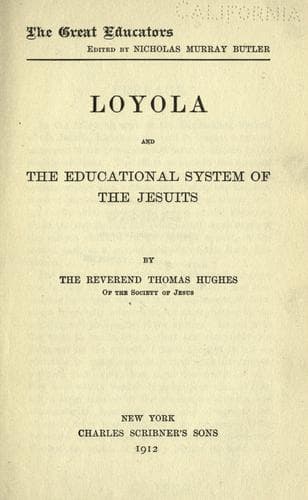
Loyola and the Educational System of the JesuitsHughes, Thomas
History
Loyola and the Educational System of the Jesuits
Hughes, Thomas
Education -- History; Ignatius, of Loyola, Saint, 1491-1556; Jesuits
Here, then, the spirit of the Constitution is fully observed, with
regard to repetition and also disputation. The Fathers remark that
Ignatius "recommends nothing with more urgency than disputation, and
constancy in its exercise; so much stress does he lay upon it, as not
to let the students of Letters and Grammar go without it."[249] In the
lower classes it takes the form of _concertatio_ and mutual challenges,
in the matter of Grammar and literary doctrine. Here it is in its full
form; and we may pass on to consider it in the next chapter, not as a
manner of repetition, but on its own merits.
I will make the transition, by quoting an important passage or two from
the preliminary _Ratio_. They bear not only on disputation, but on that
very essential point, where it is that the vital power for actuating
the whole system lies; and what is the intrinsic value of any system,
as a mere code of legislation.
The critics say that, to counteract the apparent decline of
disputation, and to restore this exercise to its ancient form and
splendor, everything depends on the vigilance and diligence of those
in authority. "Without this, nothing will be effected, even though,
for the proper administration of this department of studies, many laws
and precepts are put down in writing."[250] Elsewhere, acknowledging
in another connection that there is indeed a multitude of points
defined for observance, the same writers go on to make these pertinent
reflections: "The perfection of doctrine, like the perfection of
moral life, stands in need of many aids; whence it is that there is
no people under the direction of more laws than the Christian people,
nor any Religious Order more under the obligation of Constitution
and Decrees than our own." They undertake to prove the advantage of
this, both from the side of those in authority, and of those under
authority. "Aristotle and St. Thomas," they say, "are both of opinion
that as few points as possible should be left to the private opinions
of a judge, and as many as possible should be determined by the clear
definition of law. They prove it; for it is easier to find the few
wise men, whose wisdom is equal to the task of determining fixed rules
of guidance, than to find the multitude, which otherwise is required
to pass judgment in all contingencies of time and place; there is the
sanction of greater maturity in laws which have stood the test of time
and experience, than in the off-hand decision of the present hour;
there is less of a corrupting influence on law-givers, when they are
defining things in general and for the future. Wherefore, whatever
can be despatched by general law is so to be despatched; what cannot
be provided for by such law is to be left to the judge, as the living
rule. Under this head come the particular decisions to be passed in
given junctures, whereof the general law cannot take cognizance."
So far Aristotle and St. Thomas; and the Fathers of 1586 agree with
them.[251]
CHAPTER XIV.
Public-domain text, read in full here on John Shaqi.
Reviews
Reviews
No reviews yet
Be the first to share your thoughts on this work.
Elsewhere in the archive
Join the Discussion
Join the discussion
Sign in to leave a comment or review.
Sign InorCreate an account