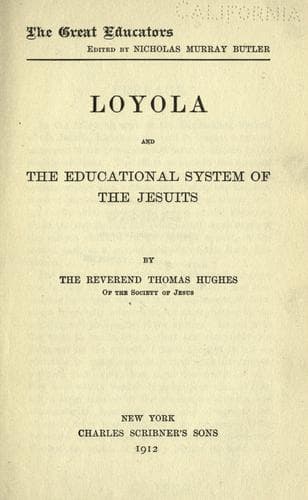
Loyola and the Educational System of the JesuitsHughes, Thomas
History
Loyola and the Educational System of the Jesuits
Hughes, Thomas
Education -- History; Ignatius, of Loyola, Saint, 1491-1556; Jesuits
To revive disputation in its best style, the critics devote several
pages to a most valuable analysis of the conditions and method of the
exercise.[258] Their suggestions are embodied in the final _Ratio_.
The Rectors are to show their lively and active interest in the
disputations, by attending on public and private occasions alike, and
by the various arts which such interest will inspire. As argument
"freezes except in a crowd," the critics require that the attendance
of all be insisted on, when the days and hours of disputation arrive.
This susceptibility of human nature, which the Fathers touch upon,
when they speak of disputation freezing except in a concourse, is not
without an exact counterpart, when, in another connection, they are
speaking of the humanists, or Professors of the literary classes. There
they adopt the view that the literary seminary of the Province should
be in the same great college, along with the faculties of Philosophy
and Theology; for, say they, among other reasons, "the humanists would
languish in obscurity, if they had not the philosophers and theologians
to be witnesses, spectators, and applauding auditors of their literary
achievements." And again they plead sympathetically, "the philosophers
and theologians, when composing the prefatory essays for their
disputations, call for the taste of the humanists, by whose verses and
orations, moreover, they are refreshed from time to time."[259]
Continuing their remarks, the Fathers define the limits of the weekly
disputations to be two hours, not more, assigning four regular
objectors for that time. The Professors, belonging to different
faculties, should invite one another reciprocally to the private
disputations in their classes, at least for an hour or so, that the
intellectual contest may wax warm by the meeting of these Doctors.
Other Doctors, too, not of the faculty, can be invited for the same
purpose. But, continues the _Ratio_ of 1599, in undertaking to push
the arguments which are being urged, "they should not take the thread
out of the hands of an objector, who is still ably and strenuously
following it up."[260] Meanwhile, the students who receive the
commission to act as objectors, on occasions of some publicity, must be
the more qualified members of the course; the others have the practice
of their private arena, until they can take part with dignity in a
public tournament.
Public-domain text, read in full here on John Shaqi.
Reviews
Reviews
No reviews yet
Be the first to share your thoughts on this work.
Elsewhere in the archive
Join the Discussion
Join the discussion
Sign in to leave a comment or review.
Sign InorCreate an account