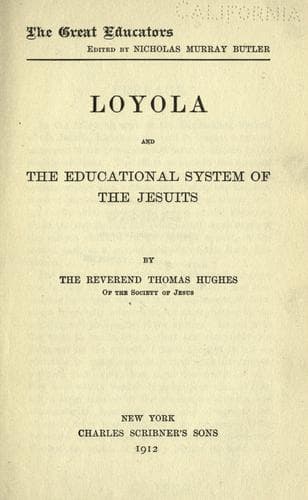
Loyola and the Educational System of the JesuitsHughes, Thomas
History
Loyola and the Educational System of the Jesuits
Hughes, Thomas
Education -- History; Ignatius, of Loyola, Saint, 1491-1556; Jesuits
These critics express their mind upon the need which exists, of
reviving considerably the fervor and dignity of this exercise, and so
restoring it to its former educational influence. But we can observe
for ourselves, how congenial an element the whole exercise must be in
a system like this, which is preëminently oral--oral examinations,
oral and self-reliant defence and attack, free and open lecturing,
with the influence of eye, voice, and person, to bring everything
home, even though all the while there is no question of oratory, but
of mere teaching. In the earlier stages, too, of the scholar's life,
however much has been made of the acquirement of style, "forging the
word with Grammar," as Robert of Sorbon had said, "and polishing it
with Rhetoric," to make it glow on the written page, yet from the very
first, also, no less account has been taken of the ability to express
one's thought, with perfect presence of mind, without depending upon
note or book. In the higher faculties, this holds good more than ever.
Now the time has come for matter of the most approved kind. And the
independent, self-possessed delivery of one's thoughts, with the power
to force them home unto conviction, or to maintain them against all
odds, appears not only as the scope proposed in the system, but also as
the historical result, effected in the public career of the Order.
Father Laynez, at the Conference of Poissy, contended thus with Peter
Martyr and others; Possevino at Lyons with Viret, using, not so much
the severe syllogistic form, as copious and learned discussion.
Maldonado was double-handed, either syllogistic or discursive. In the
Conference at Sedan, in 1572, he argued first in dialectic form; then,
on the demand of his opponents for a different kind of weapon, he
took with the same facility to discursive exposition. Edmund Campian,
in England, on being removed from the rack more dead than alive, was
immediately brought face to face with Newell and Day, able champions
as well of the Queen's spiritual supremacy, as of the doctrine of
Justification by Faith alone. He proceeded to argue: "If faith alone
justifies, it justifies without charity; but without charity it does
not justify; therefore faith alone does not justify." Now for the
answer, clear and incisive as the propositions. Deny or distinguish
major or minor proposition, if you want to deny the conclusion; for,
those premises standing, the inference remains intact, since the
syllogism is perfect in form. And so argumentations proceed.
Public-domain text, read in full here on John Shaqi.
Reviews
Reviews
No reviews yet
Be the first to share your thoughts on this work.
Elsewhere in the archive
Join the Discussion
Join the discussion
Sign in to leave a comment or review.
Sign InorCreate an account