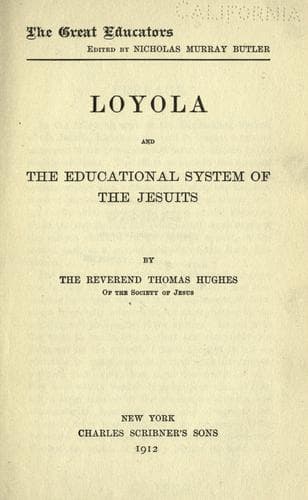
Loyola and the Educational System of the JesuitsHughes, Thomas
History
Loyola and the Educational System of the Jesuits
Hughes, Thomas
Education -- History; Ignatius, of Loyola, Saint, 1491-1556; Jesuits
With the last public act, or general defence of Philosophy and
Theology, the formation of the future Professor closes. This public
defence occupies four or five hours, in two sessions. If the defendant
is not a member of the Order, special care is taken to honor it with
all solemnity, and with the attendance of all the faculties, of guests
invited, Doctors from without, and princes or the nobility.[263]
This act will be followed by the solemnity of conferring the final
degree upon the Licentiate. When the student is a Jesuit, much more
is made of thoroughness in a searching examination then, as at all
times previously. He has now passed through a long series of yearly
examinations, which were almost always disputations, and that, not with
equals, but with four or five Professors.[264] So that, on viewing him
at the close of his formation, we are enabled to conceive, with more
distinctness, the meaning of that standard, "surpassing mediocrity,"
which, in a former chapter, I endeavored to define.[265]
2. On turning our attention now to the Professor's chair, and examining
his manner of lecturing, of explaining, of teaching, whether in the
field of Letters, Science, Philosophy, or Theology, we have, on the one
side, to suppose him complete in his formation, and, on the other, to
regard the scholar as undergoing formation. Here, then, we begin the
second part of this analysis. The style of teaching and of management,
which is distinctively the Jesuit type, is presented in the _Ratio
Studiorum_ under its practical and ideal aspect. There is also a manner
of instruction which is not considered an ideal method, however much it
may sometimes recommend itself as practically expedient. I will touch
upon this latter, the negative side of the question, first, to be free,
in the next chapter, for approaching the matter on its positive and
constructive side.
Public-domain text, read in full here on John Shaqi.
Reviews
Reviews
No reviews yet
Be the first to share your thoughts on this work.
Elsewhere in the archive
Join the Discussion
Join the discussion
Sign in to leave a comment or review.
Sign InorCreate an account