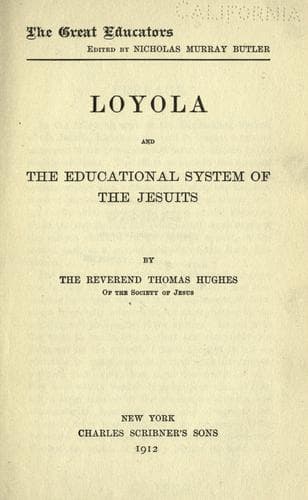
Loyola and the Educational System of the JesuitsHughes, Thomas
History
Loyola and the Educational System of the Jesuits
Hughes, Thomas
Education -- History; Ignatius, of Loyola, Saint, 1491-1556; Jesuits
In putting dictation down as not being the ideal form of teaching in
the Society, I do not speak of the proper use of dictation. The _Ratio_
itself leaves room for it. It is the abuse of dictation that merits and
receives a protracted examination of its value, at the hands of the
critics. The discussion is of the highest importance. In analyzing a
style of instruction, with which they are not in harmony, they bring
out the essential elements of all true teaching. And, if we approve at
all of their principles, the implied disapproval for the rejected form
becomes only aggravated, on contemplating an exaggerated development
of the same; that is to say, when, instead of dictating what has the
merit of being one's own laborious production, the teacher is seen to
become the servile dependant on a text-book printed by somebody else;
and neither does the teacher show any of the qualifications necessary
to have composed the book, nor does the scholar expend the industry
which would have been necessary to copy it. But it is left to speak as
best it may, is read by the teacher, instead of his teaching, is read
by the scholar as the talk of some third person, and is found, in the
last issue, to have spoken just articulately enough for the pupil to
have learnt a memory lesson, and perhaps to have gathered information
which may or may not adhere to his mental structure. But, as to
anything like mental training, or what is properly education, the final
result of a long series of years seems to show that, if there has been
any of it, possibly the man who wrote the book had it; and with him it
has remained. So must it always be under such conditions. For when the
living Master has contributed so little in the way of live education,
the scholar must, of necessity, go away with somewhat less.
These critics say trenchantly: "Let no dictation be given, unless the
explanation of very much all that is dictated has gone before, or
accompanies, or follows the dictation; where the custom does not exist,
let no dictation be introduced; where it does, an effort should be
made to do away with it, as far as possible." Then they support their
position by many quotations from the Constitution of Ignatius.[266]
Public-domain text, read in full here on John Shaqi.
Reviews
Reviews
No reviews yet
Be the first to share your thoughts on this work.
Elsewhere in the archive
Join the Discussion
Join the discussion
Sign in to leave a comment or review.
Sign InorCreate an account