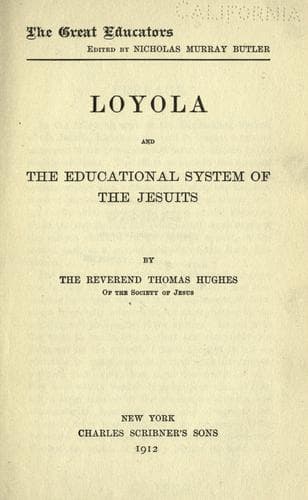
Loyola and the Educational System of the JesuitsHughes, Thomas
History
Loyola and the Educational System of the Jesuits
Hughes, Thomas
Education -- History; Ignatius, of Loyola, Saint, 1491-1556; Jesuits
They go on to state that this habit of dictating was a thing unheard
of till within the last forty years; "yet the auditors were not less
learned then than now." In fact, but a slight acquaintance with the
old university system of Europe will show how jealously the empire
of the spoken word was maintained--the spoken word, as distinct, not
only from reading what the Doctor had himself composed, but also from
consulting even notes, while actually lecturing. He might have the text
of Aristotle, or Peter the Lombard, before him; he might himself have
written and published works; the student might, with permission, take
down notes in shorthand, from which in part, but chiefly from memory,
he would commit the whole lecture to writing,[267] on his return from
school. It was not mere want of facilities that determined the system
so. But the objective point was, not to have learning in one's papers
and bound up; still less to have it in books, bought for the learning
that is in them, and left afterwards with the learning still remaining
there. The object was to make learning one's personal possession, and
to profess the live mastery of it, with voice, eye, and person showing
how live it was.
These Doctors continue: "The common impression in men's minds is, that
dictating is not lecturing; also that it is one thing to write after
the manner of polishing off a treatise, a different thing to have at
hand merely some brief heads and references. And, should the matter
which is dictated be from some author, the labor of taking it down is
superfluous."
The living voice actuates the mind more; it expresses, it impresses;
it arouses, suspends the attention; it explains. All these effects are
nowhere in a dead-and-alive dictation. Nor do they give satisfaction,
who append the explanation afterwards; for then both times seem to
be lost, that taken up with dictation and that with the explanation.
First, while the dictation was going on, the auditors were intent upon
writing rather than understanding; particularly as, before the end of
a sentence is come to, the beginning of it has already slipped from
the mind; and the writing has to go on, without allowing any of that
time to breathe, which is frequent enough if the Professor lectures
and explains. Secondly, when the time for explanation comes after the
dictation, the students are tired; they think they have all their
learning now, down in their papers; so they go off, or they yawn, or
they read over their copy, to see if anything is wanting.
After dictating, the Professor thinks that he has now done his part.
What follows, that is, the work of explaining, he gulps down, as best
he can,--a laborious work, requiring memory, promptitude, facility of
development, fluency of speech; whence he will gradually vanish away
into a nonentity, as we see actually taking place in some universities.
Public-domain text, read in full here on John Shaqi.
Reviews
Reviews
No reviews yet
Be the first to share your thoughts on this work.
Elsewhere in the archive
Join the Discussion
Join the discussion
Sign in to leave a comment or review.
Sign InorCreate an account