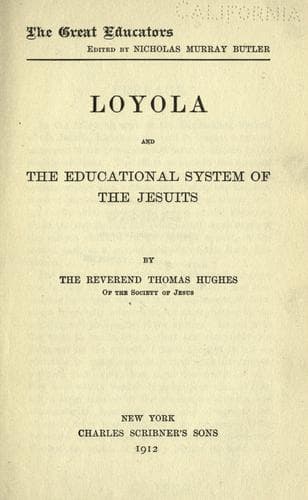
Loyola and the Educational System of the JesuitsHughes, Thomas
History
Loyola and the Educational System of the Jesuits
Hughes, Thomas
Education -- History; Ignatius, of Loyola, Saint, 1491-1556; Jesuits
The unity of matter in question, as designed for the purposes of
education, is prescribed on the strength of a double maxim; first, that
the sifting of many opinions, by the varied and multiplied activity of
many minds, leaves a residue of matter, quite solid enough to support
a compact and reliable system of teaching; secondly, that, in point
of fact, such matter, which I have called "a residue," is nothing
else than the basis of truth, divine and eternal; since, in clearing
away the ground, all the criteria of each order, the natural and
supernatural, have been faithfully and assiduously regarded.
Hereupon, intellectual concord is felt to be the result in the entire
teaching body. Of this concord the critics say, that it is the
condition and cause of a wider and profounder learning in the faculties
at large. Each Professor is engaged, "not in tilling some patch of
his own, but in contributing his industry to the general field of
all." Where is the gain, they ask, "if what one establishes, another
upsets, not as if he had always excogitated something better, but for
fear he should be thought to profit by the fruits of another's genius?
Sometimes it really makes no difference whether one or other tenet
is held; but, if we are bent on receiving no support from another,
then, for all our labor, we get no other fruit but dissension."[280] I
presume there is not a university anywhere but will bear witness, by
its internal history, to the justice of this remark.
Nor do these Fathers apprehend that reputation for real science will
suffer by such concord, since "reputation for science does not
come from opinions contradicting one another, but from their having
agreed." They express no lofty esteem for the notoriety which may be
had, by fighting no less with friends than with foes, and reserving
admiration for only what is at a respectable distance, and "turning
up one's nose at what is near."[281] This pungent remark seems to be
a new and pedagogical application of the old proverb, _Nihil vicinia
molestius_, "Nothing more annoying than one's neighbors!" They hold
that, upon a basis of concord, there is always room and liberty for
the exercise of talent; first, in those questions which are manifestly
indifferent; secondly, in thinking out new distinctions and reasons,
whereby truths already certain may be made more secure still; thirdly,
in attacking the same, either when publicly disputing, or also when
actually teaching, if what they acutely urge against a position, they
more acutely refute; fourthly, in proposing new opinions and questions,
but after they have sought the approval of the responsible authorities,
lest the labor be spent amiss. The most learned men have always been
persuaded that there is more subtlety shown, more applause merited
and comfort enjoyed, in pursuing the lines of approved and received
thought, than in a general license and novelty of opinion.[282] But
these critics throw out an idea of theirs, which quite possibly will
Public-domain text, read in full here on John Shaqi.
Reviews
Reviews
No reviews yet
Be the first to share your thoughts on this work.
Elsewhere in the archive
Join the Discussion
Join the discussion
Sign in to leave a comment or review.
Sign InorCreate an account