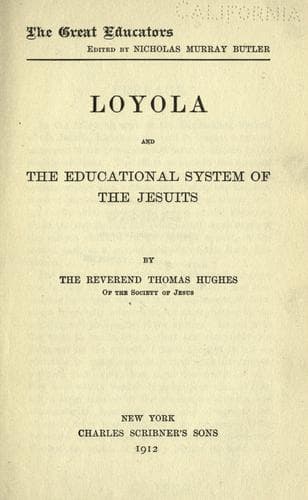
Loyola and the Educational System of the JesuitsHughes, Thomas
History
Loyola and the Educational System of the Jesuits
Hughes, Thomas
Education -- History; Ignatius, of Loyola, Saint, 1491-1556; Jesuits
not meet with universal acceptance. They say, "It is not every one who
can build up a Theology for himself." The remark they add is graceful,
that a modest genius does not court every kind of liberty, but that
which is not divorced from virtue.
These principles explain for us the unity of educational matter, as
presented to the studious world. The same marshalling and husbanding
of force, which effectuates this result, operates another, akin to
the former. It is the most definite coördination and subordination of
courses, with a mutual understanding between Professors and faculties.
Where grades exist, either in their perfect form, as in the five stages
of the classical or literary course, or in a shape approximating to
that, as in the three stages of the philosophical triennium, such
subordination is easily secured. But, also, elsewhere the conditions of
perfectly definite outlines are laid down for courses, which have any
points of mutual contact.
This may be illustrated by some rules of the _Ratio_. The two
Professors of Dogmatic Theology are to consider themselves dispensed
from commenting on questions proper to Sacred Scripture, from treating
philosophical matters, from evolving cases of Moral Theology.
The Professor of Moral Theology is to despatch with the briefest
definitions the matter which belongs to dogma. The Professor of Holy
Scripture is desired not to go at length into points of controverted
Theology. The Professor of Ecclesiastical History need not treat canons
or dogma. The Professor of Canon Law will not touch Theology or Public
Right, any more than his time permits, and the necessary understanding
of Canon Law requires. The same reserve is practised between Theology
in general, and Philosophy. Thus a Professor of Moral Theology
despatches perhaps in ten minutes the definition of Natural Law, upon
which he knows two days are spent by the Professor of Moral Philosophy.
Public-domain text, read in full here on John Shaqi.
Reviews
Reviews
No reviews yet
Be the first to share your thoughts on this work.
Elsewhere in the archive
Join the Discussion
Join the discussion
Sign in to leave a comment or review.
Sign InorCreate an account