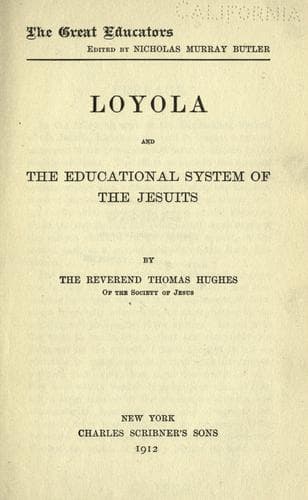
Loyola and the Educational System of the JesuitsHughes, Thomas
History
Loyola and the Educational System of the Jesuits
Hughes, Thomas
Education -- History; Ignatius, of Loyola, Saint, 1491-1556; Jesuits
As to the working of this Jesuit system, it is very much of a
commonplace, in pedagogic history, that "a handsome style" was aimed
at, and a handsome style was the outcome. The Scottish Professor,
whom I quoted on a former occasion, states very exactly the value of
this result. Speaking of the Structure of Sentences, he says: "Logic
and Rhetoric have here, as in many cases, a strict connection; and he
that is learning to arrange his sentences with order, is learning to
think with accuracy and order; an observation which alone would justify
all the care and attention we have bestowed on this subject."[316]
And, in another connection, he quotes, with the approval which it
merits, the Roman rhetorician's saying: _Curam verborum, rerum volo
esse sollicitudinem_, "I would have a sufficient care be given to
the diction, but the thoughts must be the object of scrupulous
attention."[317] This latter principle, of diction first and matter
afterwards, as translated into a process of educational development,
assigns, in the _Ratio_, five grades, or seven years, more or less,
to be spent on the acquirement of style, chiefly as to its body, or,
if you like, its form; then two great courses of Science, natural and
revealed, or Philosophy and Theology, for the acquirement of the same
style, chiefly as to its soul, or, if you wish so to call it, the
substratum of matter. From both together issues the thoroughly cultured
man; as the well-known phrase has it: _Le style c'est l'homme_, "A
style is the man himself." And, if we have just had occasion to take
notice that two of the great literary epochs of the world's history,
those of Pericles and Augustus, are made present to us by the classical
literatures, it is a subject of historical verification that a third
great literary epoch, the age of Louis XIV, was created under the
influence of this system.
The manner in which the critics of 1586 discuss the question of Greek
shows the practical eye they kept on the requirements of actual life,
and the conditions of concrete surroundings.[318] Their conclusions are
embodied in a rule of the Director or Prefect of Studies: "He should
not grant an immunity, particularly for any length of time, from either
versification or Greek, except for a grave reason."[319]
Public-domain text, read in full here on John Shaqi.
Reviews
Reviews
No reviews yet
Be the first to share your thoughts on this work.
Elsewhere in the archive
Join the Discussion
Join the discussion
Sign in to leave a comment or review.
Sign InorCreate an account