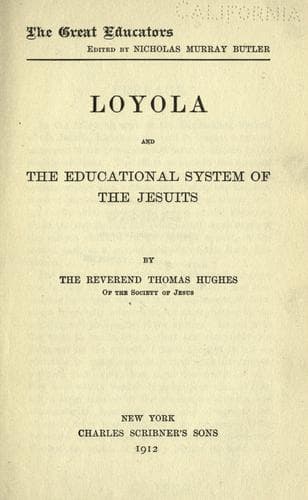
Loyola and the Educational System of the JesuitsHughes, Thomas
History
Loyola and the Educational System of the Jesuits
Hughes, Thomas
Education -- History; Ignatius, of Loyola, Saint, 1491-1556; Jesuits
To these considerations we may add one more characteristic of the
classical literatures, as instruments in the class-room, and we shall
have seen enough on our present topic, to understand the theory which
underlies the _Ratio Studiorum_. These tongues are dead. They are not
the language of common life. They are not picked up by instinct, and
without reflection. Everything has to be learned by system, rule,
and formula. The relations of grammar and logic must be attended to
with deliberation. Thought and judgment are constantly exercised in
assigning the exact equivalents of the mother tongue for every phrase
of the original. The coincidence of construction is too little, the
community of idiomatic thought too remote, for the boy's mind to catch
at the idea, by force of that preëstablished harmony which exists
among most modern tongues. Only the law of thought and logic guides
him, with the assistance of a teacher to lead the way, and reassure his
struggling conception.
And when, in the last instance, the boy comes to write and to speak the
language so learned, and quickens it, though dead, with the very life
of actual speech which makes modern languages live, we have the supreme
test and proof of successful toil, that which consists in the power
to reproduce. We have also the very specific advantage, in this case,
that the toil has been of the most valuable kind; it has been personal
labor, spent in the freshness of life on complete self-culture. For
that great law of all success in life, personal labor, has been honored
in the most remunerative way, by cultivating memory, exercising
judgment, and acquiring in the same thoughtful, reflective manner two
languages together, Latin and the mother tongue, Greek and the mother
tongue, each systematically helping the others by analogy and contrast.
And, withal, what is more congenial to the young than letters,
language, talk?
Public-domain text, read in full here on John Shaqi.
Reviews
Reviews
No reviews yet
Be the first to share your thoughts on this work.
Elsewhere in the archive
Join the Discussion
Join the discussion
Sign in to leave a comment or review.
Sign InorCreate an account