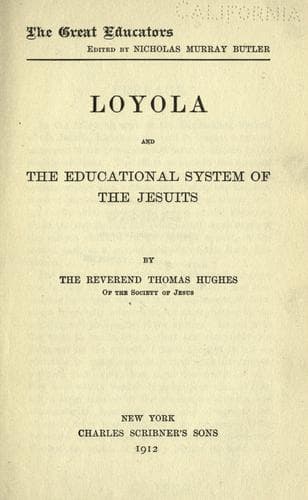
Loyola and the Educational System of the JesuitsHughes, Thomas
History
Loyola and the Educational System of the Jesuits
Hughes, Thomas
Education -- History; Ignatius, of Loyola, Saint, 1491-1556; Jesuits
A general condition in the management of a class is absolute silence
and attention. Besides, it belongs to the college programme to insure
application, not only in school to class exercises, but out of school
to private study, especially when holidays intervene. The usual weekly
relaxations scarcely rise to the rank of "holidays." For the amount
of time to be assigned in private study to composition and other
work is part of the daily order, whether the students be _alumni_,
day-scholars, or _convictores_, boarders. All must have enough to
occupy them, "that the boys be deterred from roaming about to their
hurt." The same applies to the ordinary intervals between school hours,
"particularly," say the Fathers, "on the days in summer, when there
is much time in the early afternoon, before classes are resumed; and
we hear the court-yard resounding with cries and noisy pastimes, hour
after hour."[322]
Boys were the same genus then as now. It took all the efficacy of a
benign firmness to control that element which tries the experience
of every age. The German Fathers draw a graphic picture of these
sixteenth century boys. They are commenting on the rule which requires
the Prefect of Studies at the end of school to be on the ground and
supervise. They write thus to Father Aquaviva: "Many object to this;
but it seems reasonable. For, if somebody is not on hand, some one
whom the scholars revere, then like a herd,[323] all in a heap, they
will fill the whole place with their yells and uproar, their tussling,
laughter, and jostling. Now, it is necessary to require the observance
of decorum on the part of our scholars; since, if we leave room
anywhere for unmannerliness, it will get at once into the school-rooms
and ruin everything."[324] In this sense, a certain small number of
rules in the _Ratio_, only fifteen in number, and very short, are
directly presented to the students for their observance. "None of
our students shall come to college with arms, poniards, knives, or
anything else that is prohibited, according to the circumstances of
time or place." Swords and daggers were part of a gentleman's personal
equipment in those times. "They must abstain entirely from swearing,
injurious language or actions, detraction, lies, forbidden games,
from places, too, that are dangerous, or are forbidden by the Prefect
of Schools; in fine, from everything which is adverse to purity of
morals." Other rules follow, equally radical for those times, and
reconstructive of education for the future.[325]
For, in these days of ours, we are not accustomed to see students
walk in and out of a lecture room as they choose. And many other
inconveniences of the sixteenth century are not usual with us. But the
reason is, that we come three hundred years later than those times, and
are enjoying the fruits of other people's labors.
Public-domain text, read in full here on John Shaqi.
Reviews
Reviews
No reviews yet
Be the first to share your thoughts on this work.
Elsewhere in the archive
Join the Discussion
Join the discussion
Sign in to leave a comment or review.
Sign InorCreate an account