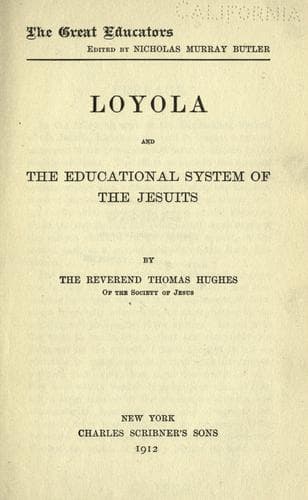
Loyola and the Educational System of the JesuitsHughes, Thomas
History
Loyola and the Educational System of the Jesuits
Hughes, Thomas
Education -- History; Ignatius, of Loyola, Saint, 1491-1556; Jesuits
An ascendency of personal tact and address, conspicuous in the Jesuit
teachers, is usually commented upon and referred to some cause or
other, in themselves or in the general organization of the Society.
Omitting that, I prefer to designate one secret of control, which is
full of significance, though not so likely to arrest attention. It
is an insensible method of organization, making its way among the
youths themselves, and subserving the purpose of general collegiate
control. There were, in all, four classes of auditors, mingled
together, and intermingling their influences. That of the strongest
of course preponderated. There were Jesuits themselves in the higher
courses. There were boarders, _convictores_, who remained for ten,
or rather eleven months of the year, entirely under the control and
direction of the Fathers. Among these were whole houses of Religious
or Ecclesiastics. Besides, there were _alumni_, day scholars, that
great body of students originally contemplated in the Constitution
of Ignatius. These, however, owing to their divided life, partly at
school, partly at home, were not found to represent, as a rule, the
fullest effects of the education. Finally, there were _externi_,
external students, such as not being entered on the books, still
attended lectures; and to this category we must refer such general
gatherings as those several thousand hearers, who were in attendance
for hours, before the time, at Father Maldonado's lectures in Paris,
and made him go out into the open air to satisfy all. Now, besides the
bond of affection which attached scholars to the Professors, there was
another bond, that of their character as Sodalists. This character
denoted membership in the Sodality of the Blessed Virgin Mary, a
religious association which is most highly commended in the _Ratio
Studiorum_, and which gathered into itself all that was excellent
in the body of students. The literary and scientific "academies"
were recruited only from the Sodality. Thus, by a double process,
an aristocracy of virtue and talent was created among the students
themselves, tending not only to the maintenance of order, but to the
active development of all those qualities which an educational system
most desires.
CHAPTER XVII.
EXAMINATIONS AND GRADUATION. SCHEDULE OF GRADES AND COURSES.
Public-domain text, read in full here on John Shaqi.
Reviews
Reviews
No reviews yet
Be the first to share your thoughts on this work.
Elsewhere in the archive
Join the Discussion
Join the discussion
Sign in to leave a comment or review.
Sign InorCreate an account