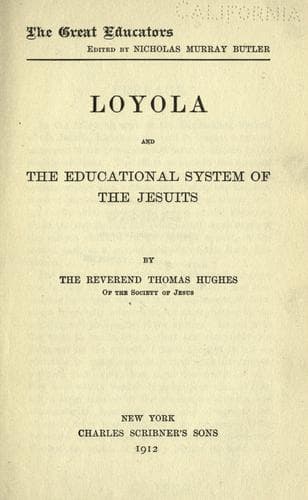
Loyola and the Educational System of the JesuitsHughes, Thomas
History
Loyola and the Educational System of the Jesuits
Hughes, Thomas
Education -- History; Ignatius, of Loyola, Saint, 1491-1556; Jesuits
In accordance with this, the _Ratio Studiorum_ is not absolute in its
general legislation, and leaves room for the special conditions of
different countries. A most distinct conception of the meaning and
process of conferring degrees may be had, by consulting the typical
constitution of an exclusively Jesuit university, as exhibited in
the _Monumenta Germaniæ Pædagogica_.[333] The third part of this
document treats exclusively of the "Variety of Academic Degrees and
the Conditions for Each." And it begins by saying: "As it is expedient
to confer Academic degrees on those who are found worthy of the same,
so the utmost caution is to be practised, lest, at any time, they be
conferred on such as would only bring the name of the Academy into
discredit, and the degrees themselves into contempt. Wherefore no
degree is ever to be conferred upon any one, who has not undergone all
the tests which the customs of universities require."
Passing on from the sixteenth century to our time, an important gap
has to be crossed in the educational history of the Order. It is
that of the Suppression, during about forty years at the end of the
last century and the beginning of the present. These blank pages
signify the total loss of property and position, with a severance in
many places of the educational traditions for almost sixty years,
and the entire destruction of them in many other parts. Besides,
like "goods derelict," the whole system of education which, by means
of the Society, had passed out of a limited number of mediæval
universities, and had been accommodated with a home gratuitously in
over seven hundred cities and towns of a dozen nationalities, was
found by the Order, at its resurrection, to be largely in the hands
of State authorities, or, at least, not independent of State control.
Restored, but having had to struggle into existence, under altered and
unfavorable circumstances, this pedagogical system may be viewed with
interest, as it stands towards the close of the nineteenth century. For
this purpose I may be allowed to glance at it, in several parts of the
world, under the precise aspect which I have just been regarding, that
of endeavoring to complete its work of education with Academic degrees.
In the United States, it has the same freedom of action as any other
system of higher education, with none of the special support which is
given to organizations endowed by the State.
In many parts of the continent of Europe, the property of the Order is
in an habitual or chronic state of confiscation, and the members, as
educators, are legally outlawed. Education can scarcely thrive when on
the wing.
Public-domain text, read in full here on John Shaqi.
Reviews
Reviews
No reviews yet
Be the first to share your thoughts on this work.
Elsewhere in the archive
Join the Discussion
Join the discussion
Sign in to leave a comment or review.
Sign InorCreate an account