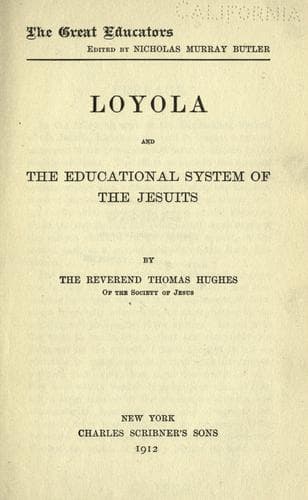
Loyola and the Educational System of the JesuitsHughes, Thomas
History
Loyola and the Educational System of the Jesuits
Hughes, Thomas
Education -- History; Ignatius, of Loyola, Saint, 1491-1556; Jesuits
Having this legislation before them, with the experience of forty
years to illustrate its working, the critics of 1586 are confronted,
at the same time, with a set of historical facts, which seem not to be
in harmony with the legislation. While Loyola's system was obviously
the organization of education, the facts, which they notice, show
a concomitant process going on, in an inverse sense, towards the
dissolution of system. This, no doubt, was owing to the disturbed
condition of the sixteenth century. Making an effort to bring the
_Ratio_ and the facts more into harmony, the critics reason in this
manner:--
"It is hard to expect everywhere that external students will be
content to hold their acts of public defence, only after their course
of Philosophy or Theology; and that, during the half-year, or the two
years specified beyond. For, in Italy, scarcely any are promoted to the
degrees by our faculties, except our own alumni, or _convictores_, who
cannot wait so long as that in expectancy, and who will readily slip
away to Medicine or Jurisprudence; nay, they are alienated from us, and
are offended at this severity, seeing that, in the other universities
of Italy, they can most easily obtain the degree if they want it.
In Germany, too, such intervals of protracted waiting are scarcely
tolerated; and they rather think they have done something, if they have
gone through a four-year course in Theology. And it would seem proper
to grant them a relaxation there; otherwise, the men are deterred from
seeking the Doctorate; so that Germany will have but few Catholic
Doctors in the future; whereas, it abounds in non-catholic Doctors,
whose promotion is to be had any day. In France, too, the philosophers
do not wait beyond the close of the triennium to be made Masters of
Arts; they could not put up with delay, for they are hurrying on to
Law. The same is the condition of things with the German philosophers,
for other reasons. Therefore the Reverend Father General might consider
whether he will dispense with the observance of the Constitution in the
Italian and Transalpine Provinces; the more so, as the Constitution
itself says that it is to be observed, as far as may be."[332]
Public-domain text, read in full here on John Shaqi.
Reviews
Reviews
No reviews yet
Be the first to share your thoughts on this work.
Elsewhere in the archive
Join the Discussion
Join the discussion
Sign in to leave a comment or review.
Sign InorCreate an account