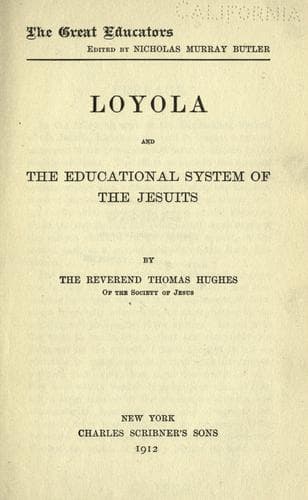
Loyola and the Educational System of the JesuitsHughes, Thomas
History
Loyola and the Educational System of the Jesuits
Hughes, Thomas
Education -- History; Ignatius, of Loyola, Saint, 1491-1556; Jesuits
From this history it appears, that, though the curriculum of Divinity
in the Jesuit system need have undergone no great change during three
centuries, beyond the usual self-accommodation of the courses to
new and pressing questions, its curriculum of Philosophy has been
materially affected, with reference to the general world of students.
This, as foreseen in the _Ratio Studiorum_ of 1586, and as referred
to again in the revised _Ratio_ of 1832, causes a double arrangement
to be made. First, wherever members of the Order are pursuing their
studies, the philosophical triennium is, as a matter of course, in full
operation, and is prolonged with individuals into a fourth year, for
reviewing the subjects and prosecuting them further; and this seminary
course, if connected with a public college, remains open as ever to the
outside world. Secondly, to meet the requirements of external students,
who do not desire the full triennium, the Provincial "will see that
a course of Philosophy be established according to the customs and
necessities of the country."[334] Hence a biennium, or two-year course,
is commonly established; and, according to the needs or desires of the
locality, it is conducted either in Latin or in the vernacular.
3. Now we may review succinctly the different courses as conducted by
the year, and as distributed through the week.
THE LITERARY CURRICULUM.
The grading is based upon the principles of a classical education.
Other branches enter a classical course, as completing the staple
studies. But, on their own merits, they receive a special distribution
of their own. The Prefect of the lower studies is instructed to
"distribute History, Geography, the elements of Mathematics, and
whatever else is usually treated in these classes, in such a manner
that each Master can satisfactorily and conveniently finish the matter
assigned to him." This is to be done "after consulting the Provincial
authority," which assures stability in the manner of organizing these
branches.[335] As to the mother tongue, the study of which is bound up
intimately with the classic literatures, a general direction is given
once for all to the Professors of these grades: "In learning the mother
tongue, very much the same method will be followed as in the study of
Latin." And, in the form of prelection to be used, they are to adopt
the method specified as peculiar to the historian and the poet, which
is more summary than the prelection of the central prose author: "Much
the same method will be followed in giving the prelection on classic
authors in the vernacular."[336]
LOWER GRAMMAR. The grade of this class is the perfect knowledge of the
rudiments, and an incipient knowledge of syntax. In Greek: reading,
writing, and a certain portion of the grammar. The authors used for
prelection will be some easy selections from Cicero, besides fables of
Phædrus and lives of Nepos.
Public-domain text, read in full here on John Shaqi.
Reviews
Reviews
No reviews yet
Be the first to share your thoughts on this work.
Elsewhere in the archive
Join the Discussion
Join the discussion
Sign in to leave a comment or review.
Sign InorCreate an account