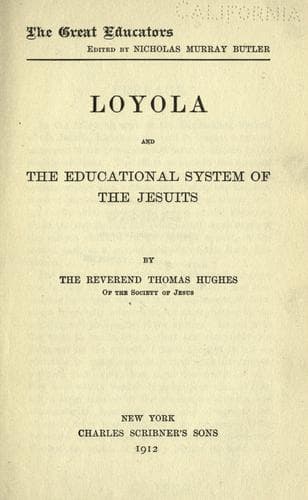
Loyola and the Educational System of the JesuitsHughes, Thomas
History
Loyola and the Educational System of the Jesuits
Hughes, Thomas
Education -- History; Ignatius, of Loyola, Saint, 1491-1556; Jesuits
MIDDLE GRAMMAR. The grade is the knowledge, though not entire, of all
grammar; another portion of the Greek grammar; and, for the prelection,
only the select epistles, narrations, descriptions, and the like from
Cicero, with the Commentaries of Cæsar, and some of the easiest poems
of Ovid. In Greek: the fables of Æsop, select and expurgated dialogues
of Lucian, the Table of Cebes.
UPPER GRAMMAR. The grade is the complete knowledge of grammar,
including all the exceptions and idioms in syntax, figures of rhetoric,
and the art of versification. In Greek: the eight parts of speech,
or all the rudiments. For the lessons: in prose, the most difficult
epistles of Cicero, the books De Amicitia, De Senectute, and others of
the kind, or even some of the easier orations; in poetry, some select
elegies and epistles of Ovid, also selections from Catullus, Tibullus,
Propertius, and the eclogues of Virgil, or some of Virgil's easier
books. In Greek: St. Chrysostom, Xenophon, and the like.
HUMANITY. The grade is to prepare, as it were, the ground for
eloquence, which is done in three ways, by a knowledge of the language,
some erudition, and a sketch of the precepts pertaining to Rhetoric.
For a command of the language, which consists chiefly in acquiring
propriety of expression and fluency, the one prose author employed in
daily prelections is Cicero; as historical writers, Cæsar, Sallust,
Livy, Curtius, and others of the kind; the poets used are, first of
all, Virgil; also select odes of Horace, with the elegies, epigrams,
and other productions of illustrious poets, expurgated; in like manner,
orators, historians, and poets, in the vernacular. The erudition
conveyed should be slight, and only to stimulate and recreate the mind,
not to impede progress in learning the tongue. The precepts will be
the general rules of expression and style, and the special rules on
the minor kinds of composition, epistles, narrations, descriptions,
both in verse and prose. In Greek: the art of versification, and some
notions of the dialects; also a clear understanding of authors, and
some composition in Greek. The Greek prose authors will be Saints
Chrysostom and Basil, epistles of Plato and Synesius, some selections
from Plutarch; the poets, Homer, Phocylides, Theognis, St. Gregory
Nazianzen, Synesius, and others like them.
Public-domain text, read in full here on John Shaqi.
Reviews
Reviews
No reviews yet
Be the first to share your thoughts on this work.
Elsewhere in the archive
Join the Discussion
Join the discussion
Sign in to leave a comment or review.
Sign InorCreate an account